Showing posts with label Buildings. Show all posts

Thursday, August 8, 2013

The Coronation of Hadrian (August 8th)

Emperor Hadrian
In the year AD 117, the Emperor Trajan was in Selinus, or modern day Turkey. During the past nineteen years, Trajan had conquered the regions of Parthia and Dacia and had started building programs in both Italy and Spain. Trajan is most famous, though, for his tolerance of Christians. This fact earned him a place in Dante's Paradiso as the only pre-Christian Roman emperor. While in Turkey, Trajan had a stroke and died at the age of 63.

On August 8th, 117, Hadrian, Trajan's adoptive son, inherited the throne. Hadrian's method of ruling was to improve rather than invade. Hadrian is responsible for many of the most recognizable buildings in all of the Roman Empire.

Among his works is the Pantheon in Rome. Though it was constructed more than a century earlier, Hadrian had the Pantheon renovated, adding the 141 foot diameter dome to the structure. Hadrian also constructed the Castel' Sant'Angelo and a villa at Tivoli, both of which still stand today.

Hadrian is most famous for his wall, which began construction in AD 122. In the north of Britain, the Picts and the Scots continuously raided cities in the Roman-controlled region of the island. To halt these raids, Hadrian began the construction of a wall, known as Hadrian's wall. This wall was ten feet wide, fifteen feet high, and stretch 73 miles from one coast of Britain to the next.. The wall also had a fort every five miles. Hadrian's Wall remains the larges construction project in Great Britain and it was the first barrier to set a distinct line between what would become England and Scotland. Hadrian continued building until his death in AD 138, at the age of 62.


Tuesday, July 6, 2010

#15- John F. Kennedy


Lee Harvey Oswald never knew his father. His father had died before Oswald was born in New Orleans. Because of having no father or steady income, Oswald had to move houses and schools frequently, attending 12 different schools during his childhood. Oswald became withdrawn and temperamental, and is known to have hit his mother and threaten his brother-in-law's wife with a knife. After being ordered to go into psychiatric observation, doctors diagnosed personality pattern disturbance with schizoid features and passive-aggressive tendencies. Although never finishing high school, Oswald became a Marxist and joined the U.S. Marines. In the Marines, Oswald was court-martialled twice and not accepted for being a Soviet sympathizer. In the end, Oswald left by saying that he had to care for his injured mother. In the October of 1959, Oswald emigrated to the Soviet Union, and announced that he wanted to renounce his US citizenship, but his application for Soviet residency was rejected. After this, Oswald attempted to cut his wrists, and this led to the KGB to recommend his deportation, but Oswald found a job in an Electronics factory in Minsk. It was here were Oswald met Marina Prusakova, whom he married in 1961. After fourteen months, Oswald brought his wife and child back to the United States. After settling in Dallas, Oswald attempted to assassinate the right-wing former general Edwin Walker, for which he was never apprehended. After the brinkmanship of the Cuban Missile Crisis, Oswald moved back to New Orleans, where he became involved in pro-Castro demonstrations and activities. Oswald also visited Cuba, with the intentions of going to the Soviet Union, but instead, went back to Dallas. On November 16th of 1963, a Dallas newspaper said that President Kennedy would be coming through the city, near the Texas School Book Depository, where Oswald was working. Oswald was last seen there by a co-worker, alone on the sixth floor about 35 minutes before the assassination. At about 12:30pm on November 22nd 1963, President Kennedy was being driven around Dallas, and as he turned left directly in front of the Depository where Oswald was inside. After one shot was fired, Texas Governor John Connally relized that it was not a firecracker, like the crowd had assumed, but a high-powered rifle. When he turned to warn the president, it was too late, for a bullet had already entered Kennedy's back and entered through his throat. After being hit, Kennedy leaned forward and to his left, where his wife, Jacqueline Kennedy, cradled him in her arms. Connally was also hit by a bullet and is reported to have said, "My God, they are going to kill us all!" A third shot was fired, which took a part off of the right side of Kennedy's head. Vice-President Lyndon B. Johnson was riding two cars behind the President, and took the oath of office on Air Force One at 2:38pm as it departed from Dallas. He became the 36th president of the United States. Police officers and spectators ran towards the Triple Underpass, but found no sniper, but Howard Brennan, who was sitting across the street from the depository, notified the police that he had seen a man with a rifle shoot from the corner window on the sixth floor. Oswald exited the building right before the police sealed it off, and took a bus home. As he walked, a police patrolman named J.D. Tippit. Oswald shot Tippit four times with his revolver before running into a shoe store, whose owner alerted the police of Oswald's whereabouts. Oswald then ran into a Texas theater without paying, and was soon tracked down by the police, who arrested him eighty minutes after the assassination occurred. Oswald was charged with the murders of J.D. Tippit and of President Kennedy. At first, Oswald denied all knowledge of the crimes, but later claimed he was a front for others. While being moved from police headquarters to the county jail, Oswald was shot by nightclub owner Jack Ruby. Oswald was was rushed to Parkland Hospital, the same hospital where Kennedy went to, but was pronounced dead while there. Although killed before his time, Kennedy accomplished much during his lifetime. He was the youngest elected president of the United States and the first Roman-Catholic president. He was a war hero and the creator of the Peace Corps. Kennedy led the country through the Cuban Missile Crisis and signed the first disarmament agreement of the nuclear age, the Nuclear Test Ban Treaty. After being killed, Kennedy's body was brought back to the White House, where his flag-draped, closed casket was moved to the Capitol for public viewing. Thousands went to see the coffin, and representatives from 90 countries, including the Soviet Union, attended the funeral on November 25th. President John F. Kennedy was buried in Arlington National Cemetery.

Tuesday, May 18, 2010

The Washington Monument

Of all the monuments in America, few are as famous as the Washington monument. In the early 19th century, the country decided to pay tribute to the man who led the fight for independence against the British. After leading the Continental Army, Washington was elected as the president of the United States in 1789. In 1833, Congress formed the Washington National Monument Society. After three years of raising money, the Society had accumulated $28,000 dollars, which they used to hold a competition for the design. In the end, Robert Mills won. With an estimated cost of $ 1 million, the tower would stand 555 feet and 5.5 inches tall and would be 55 feet and 1.5 inches wide. The construction of the obelisk started on July 4, 1848, but stopped in 1854, when the monument was only 152 feet tall. This halt was partly due to the slowing of contributions and partly because of the beginning of the American Civil War, but in 1876, when the country celebrated 100 years of being independent, Ulysses S. Grant signed the bill for the government to fund the completion of the monument. The dedication ceremony took places the day before Washington's birthday in 1885, but the public was not allowed in until 1888. The Washington Monument now stands over the National Mall in Washington, D.C., across from the Lincoln Memorial, showing the greatness and glory of the nation's first president.

Tuesday, May 4, 2010

The U.S. Supreme Court Building

In the year, 1932, construction on the U.S. Supreme Court Building started. Designed by Cass Gilbert, construction was finished in 1935. Although the first session of Supreme Court was held in 1790, the official building was not built much later on. At first, Supreme Court was held in the Royal Exchange Building of New York, but was moved to Independence Hall, and later to Philadelphia's City Hall. When the capitol was moved to Washington D.C., the supreme court was given space in the Capitol Building. From 1860 to 1935, when the new Supreme Court Building was finished, the Old Supreme Court Chamber was used to hold court sessions, but in 1929, President William Taft, who was once a Supreme Court Justice, persuaded Congress to give the Supreme Court a permanent home. The building was built on a scale to give the Judicial Branch of government the same look of dignity as the other two branches of government. Above the 16 columns on the west entrance, are the words, "Equal Justice Under Law", and the west entrance doors are cast in bronze. The east entrance of the building has the words "Justice the Guardian of Liberty" above it. On May 4th [Today] in 1987, the Supreme Court building was designated a National Historic Landmark.

Tuesday, April 13, 2010

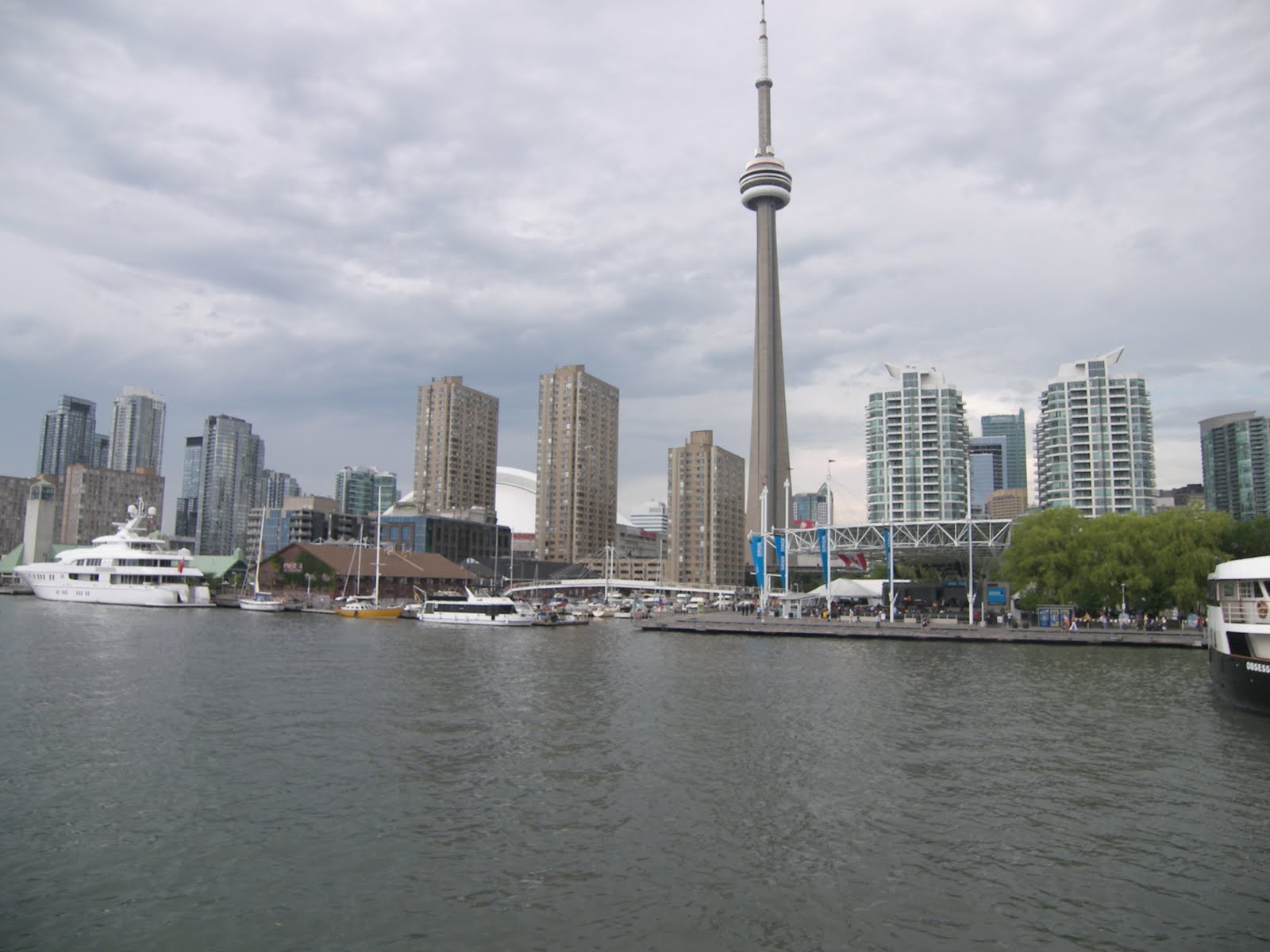
Ontario's CN Tower


The Communications Network Tower (The CN Tower) is a tower standing high over the city of Toronto, Canada. This great tower was created by a private company called CN Tower Ltd, an affiliate of Canadian National Railways. A revolving restaurant sits near the top, at 1,148 ft (350m), just above this, there is an observation deck at 1,509 ft (460m) high, but what makes this building great is that its spire is at 1,816 ft (553m) high, making it the third tallest tower in the world (not including guyed masts and drilling platforms). The tower is only behind TV & Sightseeing Tower and the Burj Khalifa. The construction of the CN Tower began in February 1973 and finished in
June of 1976. The tower stands on a foundation plate 17 ft ( 5.5m) thick with a diameter of 229 ft (70m).
The floor of the bottom observation deck is made of glass, fully of glass, but because of the height, some people refused to get out of the elevator when they saw the ground, the floor was carpeted except for one small area of the floor, where people still look down at the ground in amazement. The CN Tower now is the regarded as the most artistically significant telecommunications tower and as the symbol of Toronto.

Sunday, April 11, 2010

England's Palace of Westminster

In 1834, the old House of Parliament in London burned down. A year later, a design competition was announced, stating that the building had to be of Gothic or Tudor design, which was bad for all the leading architects, who all built classical buildings. The winner of this competition was Charles Barry, who also made buildings of classical design, but was able to create a Gothic design as requested. The building included new chambers for the Commons and the Lords, along with smoking rooms, kitchens, and libraries. The building ended up being 914ft (289m) long with two main towers, the Victoria Tower to the south and the Clock Tower (holding Big Ben) to the north. Big Ben, the bell in the clock tower, is probably the most famous part of the Palace, but took much time to get working. At first, the casting broke, and the bell was not raised until
1858, and then drowned out the parliamentary speakers, and soon before it was planned to be taken out, an adjustment of the hammer fixed the problem. Charles Barry had another man,
Augustus Welby Pugin, worked on the interior of the Palace. After many years of problems and having to garrison the building to withstand a siege, the Lords and Commons were both finally installed in their chambers in 1852. The whole building was finally finished in 1867, and now stands as one of the greatest sights in London, with the Clock Tower standing high over much of the city.

Friday, April 9, 2010

France's Louvre Museum

The Palais du Louvre is a complex of buildings added on to the first structure, which was started in 1546 by architect Pierre Lescot under King Francois I. Other parts of the Louvre were built by rulers such as Henri IV, who built the Grand Galerie, and Catherine de Medici, who built the Tuileries. The Louvre was the royal headquarters in Paris until Louis XIV built Versailles in 1682. Although he disliked the Louvre, Louis XIV's chief minister, Jean Baptiste Colbert, advised the King to build public buildings, so Louis created the Place du Carrousel. Louis also asked Le Vau, the architect who would later create Versailles, to design new buildings for the Cour Carree part of the Louvre. For the eastern facade, Le Vau, the Italian architect, Bernini, and the King's architect, Jules Hardouin Mansart all submitted designs, but were rejected. In the end, an unknown designer, Claude Perrault, was chosen. Although Perrault was only an amateur architect, his design impressed Colbert, and the eastern facade was completed in 1670. After the French Revolution, the Louvre was turned into the national gallery of France, and was added onto by both Napoleon I and Napoleon III.During the Paris Commune of 1871, the part of the Louvre built by Catherine de Medici, the Tuileries, was destroyd. In the 1980's, the French President Francois Mitterand asked Ieoh Ming Pei to reinvent the Louvre to accommodate the many visitors of the great building, so Pei added some pyramids in the middle of the complex, the main pyramid used as an entrance, the centerpiece of an underground entrance complex, and giving natural light to the underground levels. The Louvre now is one of the most famous and visited museums in the world. The Louvre now contains the Winged Victory of Samothrace, the Venus de Milo, the Mona Lisa, a coffee shop, and 4+ gift shops.

Information from...
The World's Greatest Buildings
Consultant Editor: Trevor Howells and...
The Greatest Buildings of the World
Editor: Kelly Knauer

Thursday, April 8, 2010

Belize's Xunantunich


Xunantunich is a Mayan temple and the second tallest building in Belize. Xunantunich means “Lady of the Rock” in ancient Mayan. Unlike most Mayan temples, Xunantunich does not have stairs running all the way to the top of the pyramid. Instead, the stairs go only part way up. A ramp, which starts where the stairs finish, leads to a hill on the side of the pyramid where a small room is. The ramp continues out the back door of this room and back onto the backside pyramid, when the ramp is two levels lower than the top level, the ramp stops and a new flight of stairs continues up to the top of the pyramid. Archaeologists suspect that one of the Mayan rulers of this city was loosing the support of the city’s people so he built the pyramid with these unique features. He would climb up the first short flight of stairs and go up the ramp into the small room, where servants were waiting to dress him in fancier clothing. He would then go up the ramp and climb the next flight of stairs to the top where he would reappear in front of his people. This made it seem like he had left, a human, and came back as a god. This might have help gain the people’s trust.

Tuesday, April 6, 2010

Wednesday, March 31, 2010

France's Arc de Triomphe

Although one of France's greatest arches is known as L'Arc de Triomphe de l'Étoile, it is normally known as just the Arc de Triomphe. In 1806, Napolean I of France commissioned Jean-François-Thérèse Chalgrin to build an arc to commemorate the battles of defense fought by the French Republic. When Napoleon I was exiled to Saint Helena in 1815, the construction of the arc was stopped, but when the July Revolution of 1830 brought Louis-Philippe into power, construction was resumed. The Arc now records the names of battles and generals of the French Republic and houses the Tomb of the Unknown Soldier, where an eternal flame commemorates those who died at war. The Arc is also in the center of the Place Charles de Gaulle, a round-about that merges six roads of Paris, including the Champs Élysées, one of the largest roads in Paris. When Napoleon's ashes were brought back to France in 1840, they were carried through the Arc de Triomphe in a procession. You can now go to the top of the arc to get a view of the city, but there are now elevators and the spiral staircases are longer than one would expect.

Information From...
The World's Greatest Buildings
Consultant Editor: Trevor Howells

Tuesday, March 30, 2010

California's Hearst Castle

Hearst Castle is a mansion built in 1919-30 by the newspaper tycoon, William Randolph Hearst (1863-1951). After his mother died, Hearst inherited the 250,000 acres of land where his family had lived. Hearst took this land and created one of the largest private mansions in America. With the help of architect, Julia Morgan (1872-1957), Hearst began his dream home. Hearst wanted his home to have a Mediterranean feel to it. Hearst would send men to auctions around the world to get historical artifacts for his new house. Hearst also bought medieval ceilings for his many rooms, and owned the largest collection of medieval ceilings in the world. He also kept the largest private zoo around his palace. He had bears, zebras, sheep, horses, and many other animals. Hearst Castle was always a work in progress, and was added on to whenever Hearst had a new idea for a room. Apart from his main house, the castle also included 3 guest houses, an indoor pool, an outdoor pool, and a tennis court. Though it is magnificent, Hearst Castle was never finished. There are some outside walls of the castle that haven't been completely done. When Hearst died, he asked that his house not be changed in any way, so it remains unfinished to this day.
Information From...
The World's Greatest Buildings
Consultant Editor: Trevor Howells

Tuesday, March 9, 2010

#04- Hernan Cortes


04 Hernan Cortes


After the New World was discovered, European settelers started to move west. The perfect place for the Spanish to move to was Cuba, a large Spanish colony. With all these new settelers moving to Cuba, Cuban governor Diego Velásquez, need to find more land and slave labor. To accomplish this, Velásquez sent out trips in 1516 and 1518 to explore the mainland of America. These trips, although unsuccessful, indicated a wealthy civilization just beyond the reach of the Spanish. Velásquez chose Hernan Cortes (1485-1547) to lead the trip. Leaving Cuba on February 18, 1519, Cortes went to the New World with 16 horsemen and 400 soldiers. On his way to explore, Cortes renounced Velásquez's authority and created his own city, Villa Rica de la Vera Cruz. After telling Charles V of Spain his plan of conquering the ungodly people of America, Cortes set out with two translators towards the greatest American nation, the Aztecs, convincing natives along the way to fight with him against their Aztec overlords. When Cortes reached the Aztec capital, Tenochtitlan, the Aztec emperor, Montezuma welcomed Cortes as Quetzalcoatlin, an Aztec god from prophesy. After Cortes and his men took Montezuma prisoner for a ransom of gold, a confusing mash of battles with Velásquez's men occured, Cortes' men massacred Aztec citizens during a sacred Aztec ceromony, Montezuma accidentally was killed, small pox spread throughout the Aztec nation, and Cortes finally gained control of Tenochtitlan. After Cortes claimed the empire for Spain, Velásquez got jealous and undermined Cortes' reputaion until King Charles V didn't even recognize Cortes. Although he wasn't credited with his great task, Cortes makes the great list of explorers for being the first explorer to find the Aztec Empire and took the first empire for a European country, leaving his mark on the world forever.
Information From...
http://www.ucalgary.ca/applied_history/tutor/eurvoya/aztec.html

Tuesday, February 16, 2010

#06- Amerigo Vespucci

06 Amerigo Vespucci

Amerigo Vespucci (1451-1512) came from a prominent family in Florence, Italy. In 1492, Vespucci was sent to Spain for business reasons. While in Spain, Vespucci started working on ships and became the navigator of an expedition in 1499. During this trip, Vespucci reached the mouth of the Amazon and the northern coast of South America. Vespucci went on a second trip to America in 1501, but this time, Vespucci travelled south, exploring the coast of South America, coming within 400 miles of Tierra del Fuego. During this trip, Vespucci wrote letters to a friend, and Vespucci's descriptions of his travels were the first to identify the Americas as a separate continent from Asia. Along with this information, Vespucci also described the culture of the natives of America. In 1508, Vespucci was named Pilot Major of Spain, promoting his fame. Martin Waldseemuller was a German scholar read of Vespucci's travels. He also thought that the New World was separate from Asia, so when Waldseemuller made a wood block map of the world known as the Carta Mariana, he used Vespucci's first name, which is America in German, as the name of the New World. The map sold around 1000 copies, and the name stayed. Vespucci earns many points for identifying the Americas as a separate land mass from Asia and for having two continents named after him. Vespucci died of Malaria in 1512 after a third trip to America.

Information from...
http://geography.about.com

Tuesday, January 19, 2010

California's Golden Gate Bridge

The Most Momentous Bridge in the West

In 1919, the idea of having a bridge stretching across the entrance of San Francisco Bay was first proposed. When the idea came up, Joseph Strauss, a bridge engineer from Chicago, was called in along with many other engineers. Strauss was appointed chief engineer of the project and construction started in 1933. To resist high winds, Strauss designed a conventional suspension bridge supported by two piers. Unlike many other engineers, Strauss took excessive safety precautions. He gave each worker a pair of sunglasses to protect the workers from the glare. He also had a medical team inspect the construction workers regularly. The safety net that Strauss had set up under the bridge saved at least 19 lives during construction. On May 27, 1937, the bridge opened. The bridge was 8981 feet (2737m) long and spanned 4200 feet (1280m) from pier to pier. Each pier was 746 feet (227m) tall. The Golden Gate bridge survived a lot of disasters. After having to be closed down in 1940 because of its excessive flexibility, the bridge was stiffened. The bridge went on to survive a 7.1 scale earthquake in 1989 and was strengthened to withstand a 8.3 scale earthquake. The Golden Gate has become the symbol of San Francisco and has 41 million cars travel across it every day. The great bridge is now one of America's greatest wonders and is known throughout the world as the Gate to California.

Information from...
The World's Greates Buildings
Revised and Edited
Consultant Editor- Trevor Howells

Monday, January 11, 2010

Turkey's Hagia Sophia

The Holy Place of the Roman Empire

In Istanbul lies one of the greatest churches to ever be built. Hagia Sophia, or 'The Church of Holy Wisdom' was first built by Emperor Constantine, the first Christian Emperor of Rome. Unfortunately, the church was destroyed and had to be rebuilt by Constantine's son, Constantius II, but was, again, destroyed. Emperor Justinian I resolved to build the church again, but to such a scale that nobody would ever want to destroy it again. Starting in 532, the project took 10,000 men to build and a legion of priests to continually pray over the construction sight. Hagia Sophia's dome, measuring 182 feet high and 100 feet across, was the one largest of its time, second to only the Pantheon, in Rome. Justinian succeeded in making it so great that it would never be destroyed, for when the Ottomans invaded in 1453, they were so amazed that they turned it into a mosque by adding a few minarets (Towers built next to mosques). The Ottomans helped to preserve many of the original Roman artistry on the walls of the building when they plastered over them. Because of this preservation, many of the mosaics and paintings are still there for tourists to enjoy today.

Information from...
Wonders of the Ancient World By Justin Pollard