Showing posts with label 1800s. Show all posts

Sunday, January 5, 2014

John Newton (#54)

Background

John Henry Newton was born on July 24, 1725 in Wapping, London, the son of a shipmaster. Newton's mother, Elizabeth Seatcliffe Newton was the daughter of an instrument maker from London, but she died of tuberculosis when John was only seven years old. Two years later, Newton went to live with his father's new wife, during which he attended school. 

When he was eleven, Newton worked at sea with his father. When his father retired, Newton was expected to go work on a sugar plantation in Jamaica, but Newton decided to sign on with a merchant ship in the Mediterranean instead.

Life at Sea

In 1743, Newton was captured and pressed into the naval service by the Royal Navy. He became a midshipman on the HMS Hardwich. Newton attempted to desert, but was captured and was given eight dozen lashes and was reduced to the rank of common seaman. After this event, Newton contemplated murdering the captain and committing suicide himself. Newton eventually recovered, both physically and mentally, and was transfered to the Pegasus, a slave ship bound for West Africa. 

Newton was deemed a problem by the crew of the Pegasus and was handed over to a slave dealer named Amos Clowe. Clowe took Newton to the coast and gave him to Clowe's wife, an African duchess, as a slave. Newton was abused and mistreated while there, but was rescued in 1748 by a sea captain who had been hired by Newton's father to search for him.

The sea captain returned Newton to Liverpool, where Newton acquired a slave ship Brownlow. During a voyage to the West Indies, Newton became sick with fever. While sick, Newton recognized the inadequacy of his spiritual life. He then professed his full belief in Christ. After this, in 1750, Newton married his childhood sweetheart. Newton did, however, continued working in the slave trade until 1754. 

Ministry

Newton settled down in 1755 to become a tax collector, and in his spare time, he studied Greek, Hebrew, and Syriac and soon became a well known evangelical lay minister. In 1757, he applied to be ordained as a priest of the Church of England. He was refused multiple times by the Church of England, the Methodist Church, and the Presbyterian Church. It wasn't until 1764, that Newton was accepted as the priest of Olney on the recommendation of Lord Dartmouth.

In 1767, a poet named William Cowper moved to Olney. He attended Newton's church, and the two worked together to create a volume of hymns, published in 1779 as the Olney Hymns. Among these hymns was the most famous ever written, titled "Amazing Grace". 

In 1788, Newton published a pamphlet entitled "Thoughts Upon the Slave Trade", in which he described the horrible conditions of slave ships he had experienced 34 years prior. In the pamphlet, Newton denounced slavery and expressed shame and humiliation for ever being part of the slave trade. Newton became an ally with William Wilberforce, who led the Parliamentary campaign to abolish the slave trade. 

The End

Newton lived with his wife, Mary Catlett until her death in 1790. After her death, Newton published Letters to a Wife, in which he expressed his sorrow at her passing. Newton died on December 21, 1807, but before his death, he was able to see the passage of the Slave Trade Act of 1807, which abolished slavery in the British Empire. Newton is on our list because despite entering the world of slavery and cruelty, he was able to turn his life around, write one of the most famous hymns in the world, and fight against the slavery that he once practiced.

Tuesday, October 8, 2013

Ching Shih (#58)

Background

Much of Ching Shih's early life is unknown, including her birth date and her birth name. What we do know is that she was a Cantonese prostitute who was working in the city of Canton until she was captured by pirates. In 1801, she married Zheng Yi, a notorious Cantonese pirate from a successful pirate family. Zheng Yi used military assertion and his reputation to create an alliance of pirates. By 1804, the fleet Zheng Yi created had become one of the most powerful fleets in all of China and was known as the Red Flag Fleet.

Rise to Power

On November 16, 1807, Zheng Yi died. Ching Shih, who had taken part in all of her husband's business as a pirate, began to maneuver herself into her late husbands leadership position. She began to refer to herself as Ching Shih, which means Zheng's widow, and she began to create personal relationships to get rivals to recognize her authority. 

Ching Shih further strengthened her position by gaining the support of Cheng Pao-yang and Cheng Ch'i, the nephew and cousin of her late husband. Ching Shih used Chang Pao and Cheng Ch'i to manage the fleets daily operations while she commanded the fleet as a whole. Eventually, Chang Pao and Ching Shih became lovers and later on, the two married. 

Chang Pao and Ching Shih united the Red Flag Fleet under a common code of laws which was strictly enforced. The code included rules on the division of riches taken from captured ships along with punishments for insubordination, and codes on taking captives and raiding villages.

The End


By 1806, Ching Shih's fleet was the strongest in all of the Pacific and Indian Oceans. The Chinese attempted to stop the fleet, but failed to do so and lost 63 ships in the process. Portugal and Britain also tried to defeat Ching Shih, but both failed. The navies of the three nations realized that it was hopeless and in 1810, all pirates were offered amnesty. Ching Shih took the opportunity to retire. She took her loot and opened a gambling house. She died in 1844, when it is believed that she was 69. Ching Shih is on our list for creating what was probably the greatest pirate fleet that the world has ever seen.


Thursday, October 3, 2013

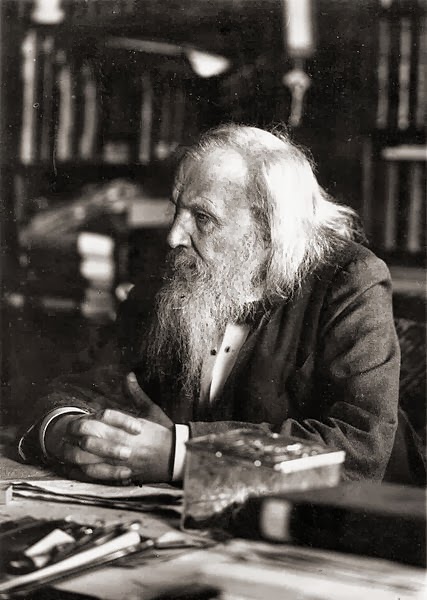
Dimitri Mendeleev (#59)

Background

Dimitri Ivanovich Mendeleev was born on February 8, 1834 near Tobolsk in Siberia. There is no consensus on how many siblings Mendeleev had, but all sources agree that the number was at least eleven. Dimitri's father supported the family by teaching fine arts, politics, and philosophy, but after some time, Mendeleev's father became blind and lost his teaching position. Mendeleev's mother was forced to restart her family's abandoned glass factory, but when he was thirteen, Mendeleev's father died and the glass factory was destroyed in a fire, so Mendeleev was sent to study at the Gymnasium in Tobolsk.

In 1850, Mendeleev's family moved to St. Petersburg and Mendeleev began to attend the Main Pedagogical Institute. After graduation in 1855, Mendeleev contracted tuberculosis and moved to the Crimean Peninsula to recover his health. While away, Mendeleev became the science master of the Simferopol gymnasium No. 1, but returned to St. Petersburg in 1857.

On April 27, 1862, Mendeleev married Feozva Nikitichna Lescheva with whom he was married to until 1882, when he became obsessed with Anna Ivanova Popova. Mendeleev divorced Lescheva and married Popova.

Career in Science

Mendeleev studied several areas in science including the capillarity of liquids and the science behind spectroscopes. In 1864, Mendeleev became a professor at Saint Petersburg Technological Institute and at Saint Petersburg State University. In 1865, Mendeleev became a Doctor of Science and achieved tenure two years later. Mendeleev is widely credited as being the man who helped Saint Petersburg become an internationally recognized center of chemistry. He is also said to have been the man who brought the metric system to Russia.

In 1869, Mendeleev was writing a book on chemistry and, while doing so, organized a table of  the 56 known elements based on atomic mass, weight, and chemical properties. This was the first periodic table ever created. Mendeleev also predicted the existence of three chemicals that would make his table make more sense. These predicted elements did exist as gallium, germanium, and scandium. The periodic table was widely expanded upon as more knowledge came in concerning the elements and their properties.

Mendeleev went on to formulate new state standards for the production of vodka in 1893 while working as the Director of the Bureau of Weights and Measures. He also helped to investigate the properties of petroleum and found the first oil refinery in Russia. He was also nominated several times for the Nobel Prize in Chemistry, but was not chosen for the award due to Svante Arrhenius, who discouraged his selection due to Mendeleev's critiques on Arrhenius's work.

The End

Before he died, Mendeleev received the Copley Medal from the Royal Society of London. He also was elected as a member of the Royal Swedish Academy of Science. Mendeleev died in 1907 at the age of 72 in Saint Petersburg due to influenza. Mendeleev has been honored by having both a crater on the moon and an element named after him. Mendeleev is on our list because he developed a table that is known world wide and can be found in almost every university and high school science classroom. Also, anyone with a moon crater named after them is pretty awesome.


Tuesday, October 1, 2013

Annie Oakley (#60)

Background

Phoebe Ann Moses was born on August 13, 1860 near Woodland, Ohio. She was the daughter of Susan Wise and Jacob Moses, the sixth child in a family of Quaker farmers. In 1866, Jacob Moses died of pneumonia and overexposure to freezing weather, leaving his family in a state of poverty.

Phoebe Ann, or Annie, began to hunt at the age of eight to support her mother and her sibling and became known for her hunting skills, but in 1870, Annie was sent to the Darke County Infirmary where she was taught to sew and decorate. She was then sent to a local family to help care for their infant son. Instead of this, Annie was forced to do many of the chores around the house and was put through both mental and physical abuse. This family, known by Annie referred to as "the wolves", didn't even give any the money she was due for her services.

In 1872, Annie returned to her family and continued to hunt for money and by the age of 15, she had paid off the mortgage on her mother's farm.

Shooting Career

On Thanksgiving Day 1875, the Baughman and Butler shooting act was being performed in Cincinnati. Marksman Francis E. Butler placed a $100 bet with hotel owner Jack Frost that he, Butler, could beat any local shooter in a competition. Frost arranged for Butler to compete with the then 15-year-old Annie. On the 25th shot of the match, Butler missed his shot, losing the match and the bet. He began courting Annie soon afterwards and married her on August 23, 1876.

Annie and Butler began to perform together, and Annie took the name "Oakley" after the neighborhood that they lived in. In 1885, Annie and Butler joined Buffalo Bill's Wild West Show. Because she was an excellent shooter but only stood 5 feet tall, Sitting Bull referred to her as "Watanya Cicilla", or Little Sure Shot, which would become her name in public advertisements. When the show went to Europe, Annie performed for Queen Victoria, King Umberto I of Italy, PResident Marie Francois Sadi Carnot of France. She had such good aim that, at his request, Annie was able to shoot the ashes off a cigarette held by Kaiser Wilhelm II of Germany. Some say that if Annie had missed and hit Wilhelm instead, she might have stopped WWI from happening.

During her time as a sharpshooter, Annie fought for women's rights, saying that women should be allowed in the military and should be taught how to use a gun. It is estimated that in her lifetime, Annie taught 15,000 women how to use a gun.

The End

In 1901, Annie was hurt in a train accident which left her in temporary paralysis that was fixed after five spinal operations. In 1902, Annie left the Wild West Show and began a career in acting, though she continued to set records in shooting until 1922. On November 3,1926, Annie died of pernicious anemia. Annie is on our list for overcoming both height and gender barriers and becoming one of the greatest sharpshooters the world has ever scene.


Thursday, September 5, 2013

Johann Strauss II (#61)

Background

Johann Baptist Strauss II was born on October 25, 1825 outside the city of Vienna. His father, Johann Strauss I, was a famous musician, but Johann Strauss Sr. did not want his son to be a musician, but a banker. Against his father's wishes, Strauss Jr. learned how to play violin from the first violinist of his father's orchestra. When his father found out, Strauss Jr. was beaten. It was not until his father abandoned his family for a mistress that Strauss Jr. was able to concentrate on his career as a composer. 

Musical Career

Strauss studied music theory under Joachim Hoffmann and continued to learn violin under Anton Kollmann. With this education, Strauss was able to gain a Viennese license to perform. Strauss's debut was made at Dommayer's Casino in October of 1844, where critics unanimously praised Strauss's original pieces. When Strauss began accepting commissions, he earned much fame and was given the musical position of Kapellmeister of the 2nd Vienna Citizen's Regiment.

As Strauss's career grew, the competition between himself and his father grew larger as well. When bourgeois revolution broke out in 1848, Strauss Jr. sided with the revolutionaries. Because of this, the musical title of KK Hofballmusikdirektor was given to Strauss Sr. rather than Strauss Jr. Johann Strauss the Younger was also arrested during he revolution for playing revolutionary music, but he was later acquited.

When his father died of scarlet fever in 1849, Strauss merged their orchestras and engaged in further touring. To regain the trust of the royalty in Vienna after his siding with revolutionaries, Strauss wrote many patriotic songs dedicated to the new Habsburg Emperor Franz Josef I. 

After recovering from a nervous breakdown in 1853, Strauss's career grew once more. Strauss began to perform in St. Petersburg in Russia in 1855 and performed their each year for ten years. Also, the KK Hofballmusikdirektor position, the musical position he had had applied for several times, was finally given to Strauss in 1863. In the 1870s, Strauss traveled to the United States, where his shows were widely popular.

The End

Strauss died in 1899 from pleural pneumonia in 1899 at the age of 73. Today, Strauss has become most famous for his piece, the "Blue Danube" waltz. Strauss is on our list for writing such a memorable piece, but also for being such a centerpiece in the music scene. Strauss inspired many composers, including Richard Wagner. Strauss was also good friends with the composer Johannes Brahms. During Strauss's lifetime, it was customary for composers to sign women's fans with their name and a section of a piece of music they wrote. When Brahms signed the fan of Strauss's wife, he inscribe a few measures from Strauss's music and wrote "Unfortunately, not by Johannes Brahms."


Saturday, August 31, 2013

Jack the Ripper (#62, August 31st)

Background

In the mid-1800s, many immigrants were flooding into London, mainly into London's East End. Irish immigrants were coming from the West, and Jewish Immigrants were coming from the East. The sudden jump in population led to worsening of conditions in London. On April 3rd, 1888, the first of eleven "Whitechapel Murders" took place in London's East End.

Murders

During the investigation process of these eleven murders, at least five are assumed to have been committed by the same person, who became known as Jack the Ripper. On August 31st, 1888, the body of Mary Ann Nichols was found, with her throat cut and her abdomen ripped open. From that date to November 9th, 1888, there were four more murders, each similar to the one described above. Each murder victim was a poor women, and each body was mutilated, some even having organs missing. 

As the police investigated the Whitechapel murders, it was assumed that the Ripper was a man who lived in London and worked during the week. This was assumed because the Ripper struck around a certain area of town each time, yet only struck during the weekend. The police first investigated surgeons, butchers, other workers who handled knives, believing that people of these occupations were more likely to kill victims by cutting them with knives. Unfortunately, all the main suspects had alibis that checked out.

There were hundreds of letters sent to the police and the newspapers whose authors claimed to be Jack the Ripper. In the letter known as the "Dear Boss" letter, the author became the first to use the name Jack the Ripper, which became a world famous name. In another letter, known as the "From Hell" letter, the author sent half a kidney, which the author claimed was the kidney of Catherine Eddowes, who had had her kidney stolen during her murder by the Ripper. The author also claimed that he had cooked and eaten the other half of the kidney. Though most letters were immediately thrown out as hoaxes, the "From Hell" letter was kept, though it was never discovered whether the kidney was indeed Eddowes's.

As the murder investigation progressed, the media caught onto the story. Tax reforms had made printing newspapers much cheaper than before, and Jack the Ripper's story was one of the first to be widely distributed throughout the city and the country. 

The End

The true identity of Jack the Ripper was never discovered, though policemen investigated the murders until 1931. Jack the Ripper became a legend, a fairy tale to scare children into being good. The Ripper's appearance also helped to bring media attention to the poor living conditions of London's East End. Jack the Ripper is on our list for being one of the few people who remain famous (or infamous) without actually having a face to put with their name.


Friday, August 30, 2013

Battle of San Juan del Monte (August 30th)

On July 7th, 1892, Jose Rizal, a Filipino writer who critiqued Spanish government, was banished from the Philippines. Because of this, Filipino patriots, led by Andres Bonifacio, founded the Kataas-taasan, Kagalang-galang Katipunan ng mga Anak ng Bayan. In English, this means The Highest and Most Honorable Society of the Children of the Nation. This Katipunan was a secret revolutionary organization that stayed secret until 1896.

In 1896, the Katipunan sent a delegation to the Emperor of Japan in order to solicit funds and weapons. When one member of the Katipunan, Teodoro Patino, went to the Spanish authorities, the existence of the Katipunan was realized. On August 26th, 1896, the members of the Katipunan tore up their identification cards and began the Philippine Revolution.

On the night of the 29th of August, 1896, Bonifacio led his men to El Polvorin, a Spanish powder magazine in San Juan del Monte. At 4:00am on August 30th, 1896, after two unsuccessful attempts at taking the powder magazine, Bonifacio made his surprise attack on the Spanish soldiers stationed at El Polvorin. Though the Spanish soldiers had rifles and the Filipinos only had bolo knives, a few guns, and bamboo spears, Bonifacio was able to take El Polvorin. The Spanish retreated, but regrouped, and with reinforcements, the Spanish were able to recapture the powder magazine, capturing 200 Filipino patriots and killing another150. Banifacio and his remaining men were forced to retreat.

On August 30th, 1896, Governor-General Ramon Blanco y Erenas declared the eight provinces of Manila under martial law. The Philippine Revolution continued until 1899, and though the Philippines was close to independence, the victory was short-lived, for that same year, Spain signed the Philippines over to America in the Treaty of Paris. Both Jose Rizal and Andres Bonifacio were executed by the Spanish Government.

Thursday, August 29, 2013

British Hong Kong (August 29th)

In 1836, the China was the center of the opium trade, but the Chinese government wanted the trade to be stopped. Lin Zexu was given the task in 1839 of suppressing opium. He went to the British and ordered them to surrender the opium trade. All the British soldiers and merchants, including the Superintendent of Trade, Charles Elliot, were confined to the Canton Factories and cut off their supplies. Elliot complied to the demands of the Chinese in order to secure passage back to England for himself and his men.

All 20,283 chests of British opium were handed over to Zexu, who had all of it burned publicly. The British Cabinet demanded that the Chinese pay for the destruction of British property. The British stressed the fact that they cared not for China's opium policies, but did care about the way the situation was handled. In 1840, when China refused to pay, Charles Elliot and his cousin, Rear Admiral George Elliot, blockaded key ports along the Yangtze and Yellow Rivers. This fighting led to the First Opium War.

In 1841, Elliot negotiated with Emperor Qishan at the Convention of Chuenpee. In the treaty that was arranged, peace would be made, but the Emperor would give Hong Kong to the British Empire. The flag was first raised in January of 1842, and on August 29th, 1842, the Treaty of Nanking was officially ratified and the island of Hong Kong was ceded to Britain, and it stayed in British hands for 100 years.

Tuesday, August 27, 2013

Krakatoa (August 27th)

Krakatoa is an Indonesian island that is the result of three volcanoes: Rakata, Danan, and Perbowatan. These three volcanoes had been active for hundreds of years, but the eruption in 1883 would be what made these volcanoes the most famous in the world.

By 1883, the area surrounding Krakatoa had been having seismic activity around the volcanoes for several years, some were so strong, they were felt as far off as Australia. In May of that year, steam began regularly venting from Perbowatan, and small eruptions of ash reached altitudes of 20,000 ft.  By the end of May, all activity had died down, but the volcanoes began erupting again around June 16th, covering the island in a black cloud. The eruptions reached their highest level of intensity on August 25th, and by the 26th, it was evident that a greater eruption was yet to come.

On August 27th, 1883, four explosions occurred on the small island of Krakatoa. At 5:30am, Perboewatan volcano erupted, creating tsunamis going North. At 6:44am, Danan volcano exploded, sending tsunamis both East and West. At 10:02am, the largest explosion took place, and was heard 3,110 km south in Perth, Australia and 4,800km west in Mauritius, where the sound was mistaken for distant cannon fire. The energy released in this explosion alone was said to be equal to 200 megatons of TNT, or four times the energy created by the Tsar Bomba, the most powerful thermonuclear weapon ever detonated.

 At 10:41am, a landslide on Rakata volcano caused the fourth and final eruption. The pressure created by the last explosion radiated out from the volcano at 1,086 km/h (675mph). The blast was so powerful, it blew out the eardrums of sailors in ships nearby. The pressure also caused a 2 and a half inch spike of mercury in pressure gauges in Batavia, and records from barographs around the world continued to pick up the volcano's shock-wave for the next five days. From these records, it has been concluded that the last eruption's shock-wave reverberated around the world seven times in total.

Hot ash from the volcano fell in Ketimbang in Sumatra later on the 27th, and approximately 1,000 people died. On the nearby island of Sebesi, only 13km off from the volcano, 3,000 were killed. Many settlements in the area were destroyed by the 30m tall tsunami. Smaller waves caused by the volcano were recorded as far away as the English Channel.

The volcanic ashed forced into the atmosphere by the eruption lowered the earth's temperature by 1.2 degrees Celsius, and it took five years for the temperature to return to normal. This ash also caused the sky to redden around the world. In New York, it was said that the sky was so red, many believed that there was a fire. In other areas, a Bishop's ring, or halo, formed around the sun.


Monday, August 26, 2013

The Nineteenth Amendment (August 26th)

In 1789, when the United States Constitution was adopted, only white males were allowed to vote for representatives. The 15th amendment was passed in 1869, giving men of all races the right to vote. The next group to rise up for their right to vote was the women.

Though many smaller organizations existed before this point, the beginning of the Women's Suffrage Movement is traditionally said to be the 1848 Seneca Falls Convention in New York.  The movement had grown, but during the Civil War, the Women's Rights movement faded into the background while the nation turned its head to a more pressing issue, slavery. When the reconstruction amendments were passed, granting 'universal suffrage', women pushed to be included, but were denied.

As Americans moved West, though, the Women's Suffrage Movement gained ground. Women's suffrage was soon established in the Wyoming Territory, Utah, and the Washington Territory. The 19th amendment was originally created by Susan B. Anthony with the help of Elizabeth Cady Stanton, who gave the bill to California Senator Aaron A. Sargent. The bill was first introduced to congress in 1878. The first vote taken on the amendment was taken in 1887, when it failed with a 16 to 34 vote. For the next three decades, the amendment was voted on several times, yet failed each time. In a 1919 vote, the amendment failed by only one vote. The bill was brought back to vote on May 19th, 1919, where it passed with 42 more votes than necessary.

The amendment was then sent to the states to be ratified. Wisconsin, Illinois, and Michigan were the first states to ratify the amendment, doing so on June 10th, 1919. Over the next year, the other states began to ratify the amendment. On August 18th, 1920, Tennessee was the 36th of 48 states to ratify the amendment, giving the amendment the two-thirds majority it needed to become part of the U.S. Constitution. On August 26th, 2013, the Secretary of State proclaimed the 19th Amendment of the United States, giving women the right to vote in America.


Tuesday, August 20, 2013

Leon Trotsky (#65, August 20th)

Background

Lev Davidovich Bronstein was born on Nobember 7, 1879, the son of a Jewish Farmer in what is now Ukraine. When Bronstein was eight, his parents sent him to school in Odessa. Bronstein stayed in Odessa until 1896, when he moved to Nikolayev for his final year of school. It was in Nickolayev that Bronstein learned the ideas of Marxism. Bronstein began meeting with political exiles and surrounding himself with other men with revolutionary ideas.

In 1897, Bronstein helped to found the South Russian Workers' Union, which got him arrested. To years later, Bronstein was put on trial and sent to Siberia. In Siberia, Bronstein met his first wife, Alexandra Lvovna, who was also in prison as a revolutionary. The two had two daughter's during Bronstein's stay in Siberia. Bronstein escaped prison in 1902, leaving his wife and two children behind. When forging a passport, Bronstein made a fake name, the name Leon Trotsky.

Under this name, Trotsky moved to London, where he met Vladmir Lenin, another revolutionary, and the two worked to founded the Social-Democrats' newspaper, Iskra. In 1903, Trotsky married his second wife, Natalia Ivanovna, with whom he had two more children.

Work in Russia

In 1905, when Bloody Sunday occured, Trotsk decided to return to Russia, where he wrote numerous pamphlets to encourage the overthrow of the Tsar's power. That same year, Trotsky led a revolution which failed. Trotsky was arrested and sent back to Siberia. In 1907, Trotsky escaped with a deer-pulled sleigh. Trotsky fled the country, living in cities throughout Europe and America. Trotsky was in New York when the Tsar was overthrown, and arrived back in Russia in May of 1917.

Trotsky became the leader of the 1917 Russian Revolution, officially joining the Bolshevik Party in August. Lenin would become the leader of the Soviet Union with Trotsky as his second-in-command. Trotsky negotiated the treaty with Germany to end the Soviet Union's involvement in World War I, and later, Trotsky became the leader of the Red Army.

Before Lenin died, he named Trotsky as his successor, but when Lenin died in 1924, Trotsky was politically outmaneuvered by Joseph Stalin, who pushed Trotsky out of politics and into exile, eventually forcing Trotsky to leave the Soviet Union all together.

The End

Trotsky traveled the globe, living in Turkey, France, and Norway. In 1936, Trotsky moved to Mexico. Trostky, in exile, began writing again, criticizing Stalin. Stalin accused Trotsky of a conspiracy against the Soviet Union. This began Stalin's Great Purge, where Stalin began eliminating all his political enemies. Trotsky was number one on Stalin's list. In May of 1940, Soviet agents machine-gunned Trotsky's house, but he was not killed. The Great Purge ended on August 20th, 1940, when Ramon Mercader hit Trotsky in the head with an ice pick. 

Trotsky is on our list for being one of the few leaders of the Soviet Union to stick to the Marxist ideals. Also, anybody who defies Stalin for as long as Trotsky did deserves recognition.


Monday, August 12, 2013

The Yukon Gold Rush Begins (August 12th)

Indigenous people had known of the existence of gold in the Yukon Territory of Canada for a long time, but both the Russians and the Hudson Bay Company in the region had ignored the rumors and chose to fur trade instead. There were several prospectors in the area, but none had struck real luck prior to 1896.

On August 12th, 1896, the American George Carmack was travelling with his wife, his brother-in-law, and his nephew south along the Klondike River. The group had followed rumors from previous prospectors and had discovered gold along the Rabbit, or Bonanza, Creek, a tributary of the Klondike. Since Carmack's wife, Kate, and her brother, Skookum Jim, were both Native Americans, Carmack laid claims for his relatives and himself, and the four began mining the claim soon afterwards. As the four began finding large quantities of gold, news spread and soon, mining camps were built all along Rabbit Creek.

The miners along rabbit creek were all from the Yukon territory because the ice and mountains surrounding the territory stopped the news from getting out. Eventually, mining officials in the Yukon got a message to Ottawa by sled-dog, and the news of gold in the Yukon was out. In the Yukon, or Klondike, Gold Rush, an estimated 100,000 people attempted to reach the Klondike river to make their fortunes. It is also believed that only around 30,000 or 40,000 actually made it. Among the stampeders, to the Klondike was none other than American writer Jack London.

 At total of $1,139,000 dollars in gold was discovered. This amount is equivalent to $1,000 million today. This amount of gold found meant that paper currencies increased in value, due to the gold standard tied to the currency. This helped to develop the financial panic of 1896. The amount of people who went to the Yukon and the amount of gold found made the Yukon Gold Rush one of the largest gold rushes in history.

Sunday, August 11, 2013

The Beginning of Alcatraz (August 11th)

Alcatraz is a small island situated in the center of San Francisco Bay, about 1.5 miles off shore. Native Americans referred to the place as the "Evil island", for they believed it was cursed. Juan Manuel de Ayala charted San Francisco Bay in 1775, naming the island La Isla de los Alcatraces, which translates to "The Island of the Pelicans". The name was eventually shortened to Alcatraz.

In 1846, John C. Fremont bought Alcatraz in the name of the United States for $5,000. In 1850, Millard Fillmore order that the land be set aside for military use. Camp Alcatraz, Alcatraz's first military garrison, was set up after the California Gold Rush began. In 1861, Alcatraz Citadel was created, which was meant to hold Civil War prisoners. Military prisoners began to be put into Alcatraz from the Civil War through the Spanish American War and First World War.

In October of 1933, Alcatraz was acquired by the United States Department of Justice, and the island became Alcatraz Federal Penitentiary. On August 11, 1934, the first 137 prisoners were brought to the Alcatraz Federal Penitentiary. Before it closed, the prison held many of the biggest criminals in American history, including Al Capon, Robert Franklin Stroud (the Birdman of Alcatraz), and George "Machine Gun" Kelly. During its 29 years of operation, the penitentiary claimed that no prisoner successfully escaped, though  a total of 36 prisoners made 14 escape attempts. The only hole in their record was made in 1962, when Frank Morris, John Anglin, and Clarence Anglin escaped, but were reported "missing and presumed drowned" because no bodies were found, yet there was no evidence that they reached the shores of San Francisco Bay.

Saturday, August 10, 2013

The Acceptance of Missouri (August 10th)

In 1812, land in the Louisiana Territory south of the thirty-third parallel became the state of Louisiana. Because the Louisiana Territory no longer contained Louisiana, the territory was renamed the Missouri Territory. The territory began to earn some legislative rights. Every 500 citizens were allowed to select one representative for the territorial House of Representatives. The territory also elected one delegate for the US House of Representatives.

During the War of 1812, many British and Native American attacks took place within the Missouri Territory, mainly the lands around the Missouri and Mississippi River.

In November of 1818, Missouri's territorial legislature adopted a request for statehood, which was submitted to the US Congress in December of that year. Normally, Missouri would have been accepted, but the Missouri's admission would have upset the balance between slave and free states because Missouri applied as a slave state. In 1820, Missouri entered the Union as a slave state in the Missouri Compromise. In the compromise, Missouri would enter as a slave state and Maine would be admitted as a free state. On August 10th, 1821, Missouri was admitted as the 24th state.

Missouri became the only slave state north of the 36°30′ line due to the agreement struck in the Missouri Compromise. This agreement and the admittance of Missouri started the build-up to the Civil War. 

Wednesday, August 7, 2013

The Battle of Boyacá (August 7th)

Battle of Boyaca
In the year 1819, Colombia and Venezuela were both fighting a war against the Spanish to secure independence. Venezuela was deep in the middle of a civil war, but in Colombia, or New Granada, as it was called, the Spanish had gained were in a time of relative peace, due to the iron-fisted government of Viceroy Juan José de Sámano, who took orders from the Spanish. Due to its time of peace, Bogota, the capitol of New Granada, was undefended against outsiders.

Simon Bolivar, who was at war in Venezuela, was eager to help liberate Colombia, and decided to leave Venezuela to attack Bogota. The only problem was that the Andes divided the two regions. Nonetheless, Bolivar led his men over the pass through the mountains, which was over 13,000 feet about see level. The snow, winds, and ravines were so dangerous, Bolivar lost a third of his men in the crossing, but by early July, Bolivar had made his way to New Granada and the Spanish had no idea he was there. 


Bolivar was quick to regroup his men, and many Colombian nationals were eager to join him in his march towards Bogota. On July 25th, Bolivar led his men against the Spanish forces under General José María Barreiro at Vargas Swamp. Though the battle was a draw, the battle showed Barreiro that Bolivar was a force to be reckoned with. He also discovered that Bolivar was headed for Bogota.


On August 7th, 1819, as Bolivar regrouped and headed for Bogota, Barreiro rushed to cut him off. Barreiro sent his elite warriors, the vanguard, ahead to the bridge of the Boyacá River to keep Bolivar occupied until the main army arrived. Bolivar, however, was closer than expected. The vangaurd reached the bridge, where they waited for the rest of the Spanish army to arrive. Bolivar, however, arrived first. Bolivar sent a small group of his men, led by General Francisco de Paula Santander, to engage the vanguard while Bolivar went back for Barreiro. Bolivar surrounded Barreiro and his forces and then attacked. Barreiro, who realized he was surrounded and seperated from his best soldiers, quickly surrendered. 


Hearing news of Bolivar's smashing victory, many Spanish royalists, including Bogota's Viceroy Juan José de Sámano, fled the city. Several days later, Bogota was captured and Colombia had gained its independence from Spain. The Battle of Boyacá is now considered to be the the battle in which Colombia gained its independence.


Monday, August 5, 2013

The First Transatlantic Message (August 5th)

In 1839, the first widely used telegraph was created by William Cooke and Charles Wheatstone, which could, theoretically allow near-instantaneous communication across the entire world. The only problem with this worldwide communication network was the presence of oceans. To get a cable across the oceans, it would take massive amounts of money and international cooperation.

The idea had been supported by many, including Samuel Morse, and the concept had been proven when a cable was set between England and France, and later between two islands in Canada.

In 1853, the idea picked up enough momentum and a project to get a telegraph cable across the Atlantic was put in motion, led by Cyrus West Field and Charles Tilston Bright.

One problem that the project encountered was the money needed to make the cables. Each section  cable was made up of seven copper wires covered with three coats of gutta-percha leaves, tarred hemp, and eighteen groups of seven iron wires. The British government gave the project both subsidies and ships needed to complete the project, but Field also went to Congress to gain monetary support. Due to a large amount of anglophobes among congressmen, the subsidy bill passed in the Senate by a single vote and barely passed in the House of Representatives as well.

The first two attempts to carry the cable across the Atlantic both failed due to breaks in the cable, but the feat was attempted again one years later. In 1858, the HMS Agamemnon began laying the cable westward from the United Kingdom and the  USS Niagara did the same, making its way east from the United States. On this attempt, the two halves of the cable did not break and the cables were successfully spliced. An the entire cable was sent to the bottom of the ocean.

On August 6th 1858, Queen Victoria and United States President James Buchanan set each other greetings by telegraph, becoming the first people to use the Transatlantic telegraph.


Saturday, August 3, 2013

Typhoid Mary (#70)

Background

Mary Mallon was born on September 23rd, 1869 in Cookstown, County Tyrone in what is now Northern Ireland. Malon was what is known as an asymptomatic carrier of the pathogen which causes typhoid fever. Most likely, she was a survivor of a previous episode of typhoid fever, yet she did not get rid of the associated bacteria, known as Salmonella typhi. This meant that she could spread the disease through contact with food and water

Cooking and Investigation

Mallon moved to the United States in 1884. In 1900, she became a cook in the Mamaroneck, New York. Within two weeks of her employment, residents of the town had developed typhoid fever. In 1901, she moved to Manhattan in 1901 to work for a family, eventually all the family members for whom she worked with developed fevers and diarrhea. The laundress of the household died of the fever. Soon afterwards, Mallon went to work for a lawyer, and during this time, seven of the eight family members developed typhoid. In 1906, Mallon worked under four different families, and each family suffered from typohoid fever.

In the winter of 1906, a family hired a typhoid researcher named George Soper. He discovered that a cook was hired just weeks before the outbreak, and several weeks afterwards, she left. Soper believed there to be a connection to the cook, and when he discovered she was an single Irish woman of about forty, he was able to track Mallon to a recent outbreak of typhoid fever near a Park Avenue Penthouse. When Soper approached her, she refused to give urine and stool samples. Soper began a study on Mallon's previous work history, finding that Mallon had worked for no less than eight families that had an outbreak of typhoid fever during the same time period. 

Quarantine 

After Soper's research went out, the New York City Health Department sent Dr. Sara Baker to talk to Mallon. Mallon refused to go with Baker because she believed that she was being persecuted when she had done nothing wrong. Baker went back to Mallon several days later, this time with police officers, who took Mallon into custody. Mary attracted so much publicity, she became known as Typhoid Mary. 

When questioned, Mary said she rarely washed her hands when cooking, saying there was no need. Urine samples taken from Mallon showed that her gallbladder carried large amounts of typhoid salmonella. Mallon, however, refused to have her gallbladder extracted or give up her occupation, maintaining that she did not carry the disease at all.  Mallon was held in isolation for three years before being released by Dr. Eugene H. Porter, who said it was wrong to isolate disease carriers. She was, however, released on the promise that she would not return to her job as a cook.

Mallon was given a job as a laundress, but it paid less than cooking. Soon, Mallon decided to return to being a cook, but to avoid notice of both the public and the authorities, she changed her name to Mary Brown. For five more years, she served as a cook in a number of kitchens, followed by typhoid fever. She changed jobs quickly, though, and Dr. Soper was unable to find her. In 1915, a serious epidemic of typhoid erupted among the staff of the Sloane Hospital for Women. Two cases proved fatal. When a cook matching Mallon's description suddenly disappeared, the police were able to track her to an estate on Long Island. 

The End

Mallon was arrested and spent the rest of her life in quarantine. She was frequently interviewed by journalists, but none were allowed to even accept a glass of water from her. Eventually, she was allowed to work as a technician in the laboratory close by. In 1932,  Mallon was paralyzed due to a strok, and on November 11, 1938, she died of pneumonia. Typhoid Mary is on our list of people because she was the first person in the United States to be identified as an asymptotic carrier of typhoid fever.

Friday, August 2, 2013

The Death of Wild Bill (August 2nd)

In 1876, James Butler Hickok, better known as Wild Bill, was staying in the city of Deadwood, in what is now South Dakota. Wild Bill was a hero of the American Old West, gaining fame as a Civil War soldier, a scout, a marksman, and as a professional gambler. He was also famous for his work as a lawman and for being involved in quite a few shootouts.

On August 1st, Hickok was playing poker at Nuttal & Mann's Saloon, against several other men, including buffalo hunter Jack McCall. McCall had lost all his money by the end of that day. At the end of the day, Hickok had given McCall enough money to pay for breakfast.

The next day, on August 2nd, Hickok returned to the saloon for a drink. Hickok was invited to play in another game of poker, and Hickok accepted. Hickok, however, had a habit of sitting with his back against a wall so that nobody could sneak up behind him. The only empty seat at the table that day was the one with its back to the saloon door. Twice during the game, Hickok asked to switch seats, but both times, he was refused.

While playing, Jack McCall walked in the saloon, and walked up behind Wild Bill. Hickock, unaware of McCall, continued playing. McCall drew his pistol and shot Hickok in the back of the head, killing him instantly. The motive for the murder is unknown, though many speculate that Hickok's donation of money to McCall might have been taken as condescending, though McCall claims that he was avenging his brother, who he claims was killed by Hickok, though there is no solid evidence for or against this claim.

Wild Bill Hickok was buried in Deadwood, and almost the entire town attended the funeral. Hickok's murder only served to strengthen his own legend, and his many adventures became part of American folklore. When shot, Hickok was holding a pair of aces and a pare of eights, all black. The fifth card's identity has been debated. These four cards have been named "The Dead Man's Hand."

Tuesday, July 30, 2013

Gunnar Kaasen (#71)

Background

Gunnar E. Kaasen was born on March 11, 1882 in Burfjorddalen, Norway, the son of Hans and Anna Kaasen. In 1903, Kaasen headed to the United States to mine for gold, after the discovery of gold in Cape Nome in 1898. Although the gold rush was over by 1905, Kaasen was able to find work in Nome as a musher, or dog sledder. The work was profitable and in high demand because the port of Nome is usually ice locked between October and June each year.

Great Race of Mercy

In 1925, an outbreak of diphtheria spread rapidly through the city of Nome. Many of Nome's residents, especially the Inuit children of the town, had little to no immunity to diphtheria and needed medicine. Unfortunately, Nome's diphtheria antitoxin supply had run out. With no trains, no planes, and a frozen port, Alaskan Governor Scott Bone decided that the only way to get serum to Nome was to transport it from Anchorage to Nome by dogsled. The 674 mile (1,085 km) trek was divided up into twenty legs, each manned by a different musher and a different team of dogs. Gunnar Kaasen was scheduled to run the second-to-last leg of the route with his dog Balto and twelve other huskies. By the time the antitoxin reached Kaasen, the route was covered by a massive storm. It was said to be so bad that Kaasen could not see the dogs closest to the sled and that the winds almost blew the serum off of the sled. At 2am on February 2nd, Kaasen reached the end of his leg. Because Kaasen reached the end of his leg ahead of schedule, the next musher, Ed Rohn, was asleep and no one was at the transfer location to meet Kaasen,so despite the storm, the cold, and his tired dogs, Kaasen led his dogs onward to complete not just his own leg, but the remaining 25 miles (40 km) to Nome as well. Kaasen reached Nome at 5:30am. Kaasen and his dog team had traveled 54.3 miles (87 km) total. Kaasen delivered the serum to Dr. Curtis Welch, who destributed the serum. There were no further deaths from the disease in the city after that.

The End

Kaasen received a medal from the Governor of the Alaska Territory and a daily wage of $30 dollars from the government along with all other mushers. Kaasen himself became a celebrity along with his dog Balto, whose statue is now standing in Central Park in New York City. The Iditarod Trail Sled Dog Race commemorates the 1925 serum run. Kaasen moved to Everett, Washington in 1952, where lived until his death on November 27, 1960.

Saturday, June 29, 2013

Alvin York (#72)

Background

Alvin Cullum York was born on December 13, 1887 was born in a log cabin in Pall Mall, Tennessee, the third of eleven children born to Mary Brooks and William York. William York worked as a farmer and a blacksmith, and the family collected its own wood and made their own clothing. Alvin York only attended school for nine months because his father wanted him to help run the farm and hunt game. In 1911, William York died, and because Alvin was he oldest sibling still in the country, he supported the family as a logger and as a railroad worker. During this time, he gained a reputation as an alcoholic and as a fighter. This continued until 1915, when he converted to Christianity. He joined the Church of Christ in Christian Union, which was opposed to all forms of violence.

World War I

Because of his religious views, York was worried when the United States entered World War I in 1917. York, like all other men between the ages of 21 and 31, was forced to sign up for the draft. On his draft form, there was a question that read "Do you claim exemption from draft?", and York responded by writing "Yes. Don't want to fight." His claim was denied. He was drafted into the United States Army and served in Company G, 328th Infantry Regiment, 82nd Infantry Division at Camp Gordon, Georgia. Other soldiers convinced York of the morality of the war, and York became convinced that God would keep him safe.

Medal of Honor

Under the command of Sergeant Bernard Early, Cpl. York and seventeen others went behind German lines to take out the machine guns. The group made their way to the German headquarters, capturing a large group of German soldiers, but while dealing with the prisoners, the group was showered with machine gun fire. Nine soldiers were killed, including Sergeant Early. This left York in charge of the remaining seven U.S. soldiers. He told his men to get undercover, then York worked his way to the German machine guns. The machine guns began open firing at York, who returned fire with his rifle. Even though there were over 30 Germans on duty around the machine guns, York picked them off, one by one. When six Germans charged him with bayonets, he drew his Colt automatic pistol and shot all the soldiers before they reached him. After emptying his pistol while trying to hit York, German First Lieutenant Paul Jurgen Vollmer offered to surrender the unit to York, who accepted. York and his seven men marched back to American lines with 132 German prisoners. York was honored with the American  Distinguished Service Cross, the Medal of Honor, the French Croix de Guerre and Legion of Honor, and the Italian Croce di Guerra al Merito.

The End

York's story was relatively unknown until 1919, when his story was published by George Patullo in the Saturday Evening Post, which made him an American hero. He died on September 2, 1964 of a cerebral hemorrhage. Over the course of his life, he received over fifty decorations. Alvin York is on our list because he has one of the most epic war stories of all time. He is a true hero of the battlefield.