Showing posts with label World. Show all posts

Saturday, June 12, 2010

#18- Reinhard Heydrich

Out of all the Nazis, Reinhard Heydrich (1904-1942) was at the top of the Nazi heap. Along with being a senior SS officer and being considered as a possible successor of Hitler, Heydrich was the head of the Reichssicherheitshauptamt (RHSA), the Reich Security Head Office, but Heydrich was most important for attending the Wannsee Conference of 1942, where Nazis agreed plans for the extermination of the European Jews. Heydrich started out in a good childhood, being able to play violin and many sports, but his prospects went down when he was dismissed from the German Navy in 1931 for unknown reasons. Many believe that Heydrich was dismissed for spying on naval personnel for the Nazis. This idea was strengthened by the fact that soon after the event, SS Leader Heinrich Himmler appointed Heydrich to expand the SD (Sicherheitsdienst) soon afterwards. After 1932, Heydrich started hopping up the Nazi hierarchy. Having done well in recruiting people to the SD, he was given control of the Gestapo, or the Geheime Staatspoliziei, in 1934. The Gestapo was the civil secret police. Two years later, the Gestapo was merged with the criminal-investigation police into the SiPo (Sicherheitspolizei, or Security Police) under Heydrich. After becoming the head of the RHSA in 1939, he ran both the SD and the SiPo. Heydrich was cruel, competitive, and aggresive, which led to Himmler giving him the nichname 'Genghis Khan'. It was Heydrich who planned the ruse if a Polish attack on German forces at Gleiwitz that later led to the Nazi invasion of Poland in 1939. In November of 1938, Heydrich was made the head of the Central Office for Jewish Emigration, which he used to assert SS dominance over Jewish Policy, which culminated at the Wannsee Conference of January 20, 1942, where the 'Final Solution' of the Jewish people was sealed. In September of 1941, Heydrich became the Reichsprotektor of Bohemia and Moravia. This post was important to the Nazi war effort, because many of Germany's guns and tanks came from that area of Europe. Heydrich understood this, and held strict rules for those who did not reach their daily quota and those who took part in any resistance. Heydrich's success led Hitler to consider promoting Heydrich to the position of governor of Paris. This news led British inteligence to protect the French Resistance network from Heydrich's ruthless ministrations. In December of 1941, the British sent Jan Kubis and Jozef Gabcik, two Czechs who had fled their country in 1941, to Czechoslovakia to assassinate Heydrich. Heydrich was known for his display of riding in an open car. On May 27, 1942, Kubis and Gabcik used this habit to their advantage. When Heydrich's car was turning a bend in the suburbs of Prague, Gabcik pulled out a Sten 9mm submachine-gun, but the magazine jammed, and would not work, so Kubis threw an anti-tank grenade at the car in desperation, which exploded on the car's boot, but also in Kubis's face. Heydrich, at the time, appeared to be only lightly hurt, for he was able to jump out of the car and chase after the two assassins, but his gun, also, was not loaded. After a while, the shock of the wounds set in and Heydrich had to send his driver after the assassins instead of himself. Although Himmler sent Heydrich his best doctors, Heydrich's horsehair upholstery had allowed bacteria and toxins to give Heydrich septicaemia, and he died on June 4th of 1942. Two weeks later, Gabcik and Kubis were cornered by German troops in the church of St. Cyril and St. Methodius in Prague. After the two realized that the Germans would overrun the church, the two went into the crypt and committed suicide. Heydrich might have been governor of Paris had he lived a few years longer, and he might have uncovered the French Resistance while there, but he did not survive, helping the allies along with their fight.

Information from...
ASSASSINATED!
By Steven Parissien

Friday, May 21, 2010

Charles Lindbergh and Amelia Earhart


Today in History:

Today (May 21) was the day that both Charles Lindbergh and Amelia Earhart crossed the Atlantic. It was in 1927, at 7:52am on May 20th that Charles Lindbergh went down Roosevelt Field in The Spirit of St. Louis, a monoplane only 28 feet long. After leaving Long Island, Lindbergh went north to Cape Cod and Nova Scotia, crossing the Atlantic over the night. After sighting a small fishing boat, he knew he was reaching Europe, and soon flew over England, Ireland, and soon afterward, on May 21st, landed at the Le Bourget Airport, surrounded by 10,000 onlookers, who mobbed his airplane. Lindbergh had flown 3,610 miles in 34 hours.The next day, in front of the American Embassy in Paris, President Gaston Doumerque of France gave Lindbergh the Legion of Honour. After coming back to the U.S. (by boat) President Calvin Coolidge of the United States presented him with the Distinguished Flying Cross. When Lindbergh arrived in New York, the financial market closed for 'Lindbergh Day', and a parade with 10,000 soldiers and sailors went through the city. On May 21st in 1932, exactly 5 years after Lindbergh arrived in Paris, the American, Amelia Earhart, landed in a field near Londonderry, Northern Ireland after flying 15 hours. She became the first woman to fly solo across the Atlantic. Earhart recieved the National Geographic Society gold medal from President Herbert Hoover of the United States and the Distinguished Flying Cross from Congress, and soon became an early feminist icon. Both Lindbergh and Earhart changed history by what they did on May 21st.

Information From...
Great Stories from History for every day of the year
By W.B. Marsh and Bruce Carrick

Friday, April 30, 2010

Louisiana Purchase


Today in History:

On April 30, 1803, the Louisiana Purchase was sold to the United States by France. Although France had ceded the territory to Spain in 1762, the Treaty of San Ildefonso, signed in 1800, regained the Louisiana Territory. Napoleon Bonaparte (1769 – 1821), or Napoleon I of France, was set on creating an French Empire in America along with a French Empire in Europe. This American Empire was going to be centered around the island of Hispaniola. Unfortunately, Haitian slaves under Toussaint L'ouverture (1743-1803) had revolted and taken over the city of Santo Domingo on Hispaniola. Although Napoleon had sent an army to put down the rebellion, many soldiers died in battle and of yellow fever. This destroyed Napoleon's American Empire dream, so he decided to sell the land to help fund his military in France. Although President Thomas Jefferson of the United States had already sent James Monroe and Robert R. Livingston to negotiate the purchase of a portion of the land, he was delighted when Napoleon offered the whole territory to him. The purchase was sold on this day for 60 million francs or about $15 million. The land was 2 million sq. kilometers (800,00 sq. miles) stretching from the Mississippi River to the Rocky Mountains. This doubled the size of the United States and lead it to expansion across North America. It is strange to think what might have happened if Napoleon had stopped the slave revolt and started the American Empire of France. The United States would be limited to the East Coast of North America and France would have a very large influence on the culture of all of the Americas.

Information from...
http://www.gatewayno.com/history/LaPurchase.html

Tuesday, April 13, 2010

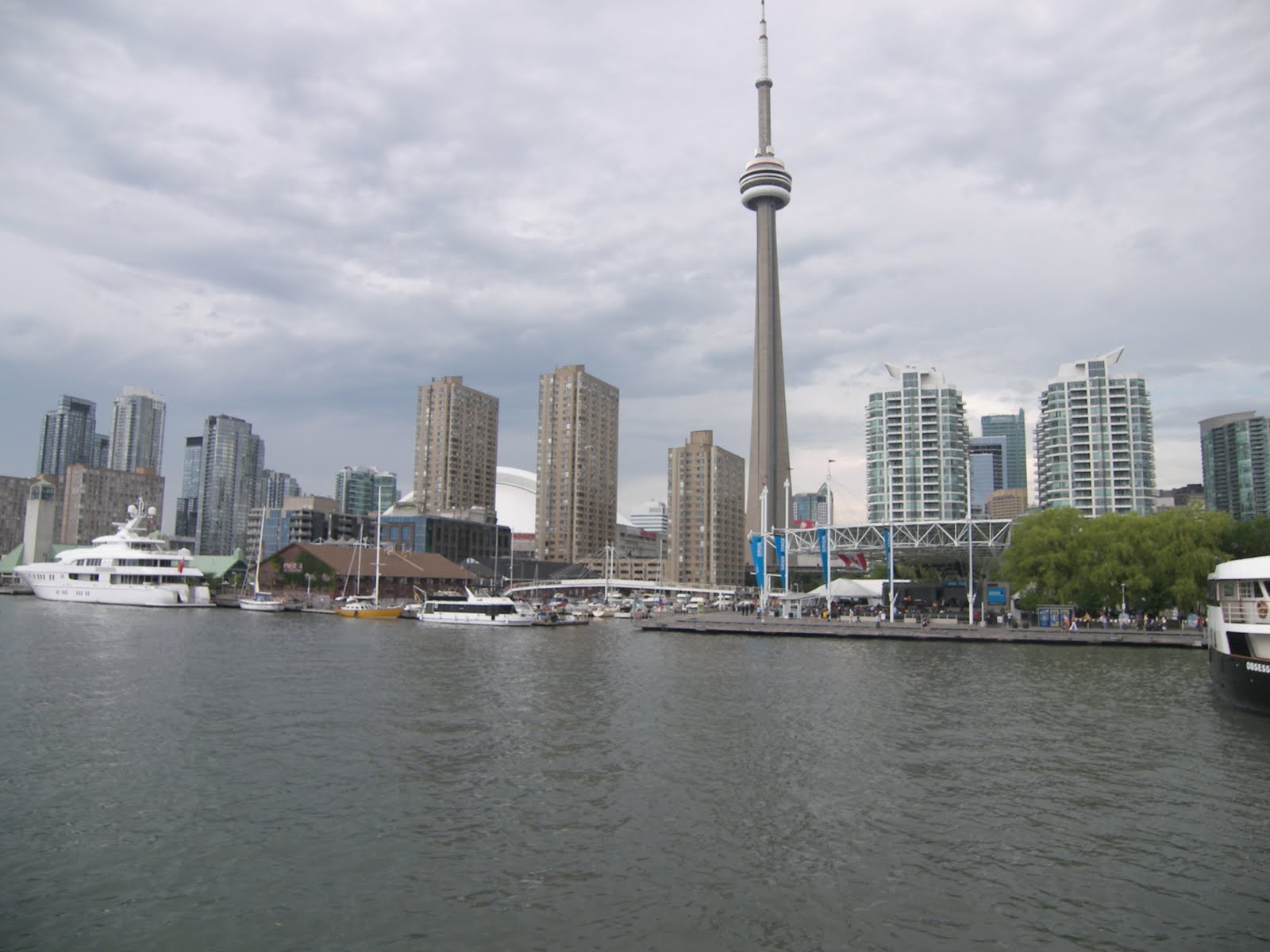
Ontario's CN Tower


The Communications Network Tower (The CN Tower) is a tower standing high over the city of Toronto, Canada. This great tower was created by a private company called CN Tower Ltd, an affiliate of Canadian National Railways. A revolving restaurant sits near the top, at 1,148 ft (350m), just above this, there is an observation deck at 1,509 ft (460m) high, but what makes this building great is that its spire is at 1,816 ft (553m) high, making it the third tallest tower in the world (not including guyed masts and drilling platforms). The tower is only behind TV & Sightseeing Tower and the Burj Khalifa. The construction of the CN Tower began in February 1973 and finished in
June of 1976. The tower stands on a foundation plate 17 ft ( 5.5m) thick with a diameter of 229 ft (70m).
The floor of the bottom observation deck is made of glass, fully of glass, but because of the height, some people refused to get out of the elevator when they saw the ground, the floor was carpeted except for one small area of the floor, where people still look down at the ground in amazement. The CN Tower now is the regarded as the most artistically significant telecommunications tower and as the symbol of Toronto.

Saturday, April 10, 2010

The Elephant Seal

This blog is called the History Dropoff because it is where I drop off facts on mainly history, but I use this blog to keep my family from having to listento me, so I also dropoff other information, like this post.


The Elephant Seal is a species of seal that comes in two types of species. The Northern Elephant Seal is known as Mirougna angustirostris and lives on the coast of California and Mexico, while the Southern Elephant seal, Mirougna leonina, lives only in the southern hemisphere, in places such as New Zealand, South Georgia, Antartica, etc. Elephant seals are marine mammals that come together only to breed. The Northern variety breed in January and February, but the Southern species mates from September to October. Although Elephant Seals are clumsy on land, they can swim with great power deriving from the alternating hind flippers, which they can use to catch fish and squid. The most unique feature of an elephant seal is its large nasal cavity, which only appears on males and takes 8 years it to fully develop. During mating season, the cavity fills with blood and is able to amplify aggressive roars. Along with having an odd nose, male elephant seals also have many other traits that females do not, which the bulls use during battles for dominance. Males can weigh up to 2300kg more than a female, weighing in at about 3200kg (7055lb). Males are also longer than females and can be 4.9m (16ft) long. Other outstanding battle traits used by bull Elephant Seals are tough neck skin acquired as a youth and enlarged canines. Elephant seals can have cubs when the male is 4 to 6 years old and the female is 2 to 3 years old, and after 11 months, the seal gives birth to a youth, which will hopefully live for another 20 years. Although Hooded seals (Cystophora cristata) also have traits like those of an Elephant Seal, they're not as large as Elephant seals, and their nasal cavities are no match to those of an Elephant Seals, the Elephant of the Sea.


Infromation from...
The Encyclopedia of Animals
Consultant Editor: Dr. Per Christiansen

Friday, April 9, 2010

France's Louvre Museum

The Palais du Louvre is a complex of buildings added on to the first structure, which was started in 1546 by architect Pierre Lescot under King Francois I. Other parts of the Louvre were built by rulers such as Henri IV, who built the Grand Galerie, and Catherine de Medici, who built the Tuileries. The Louvre was the royal headquarters in Paris until Louis XIV built Versailles in 1682. Although he disliked the Louvre, Louis XIV's chief minister, Jean Baptiste Colbert, advised the King to build public buildings, so Louis created the Place du Carrousel. Louis also asked Le Vau, the architect who would later create Versailles, to design new buildings for the Cour Carree part of the Louvre. For the eastern facade, Le Vau, the Italian architect, Bernini, and the King's architect, Jules Hardouin Mansart all submitted designs, but were rejected. In the end, an unknown designer, Claude Perrault, was chosen. Although Perrault was only an amateur architect, his design impressed Colbert, and the eastern facade was completed in 1670. After the French Revolution, the Louvre was turned into the national gallery of France, and was added onto by both Napoleon I and Napoleon III.During the Paris Commune of 1871, the part of the Louvre built by Catherine de Medici, the Tuileries, was destroyd. In the 1980's, the French President Francois Mitterand asked Ieoh Ming Pei to reinvent the Louvre to accommodate the many visitors of the great building, so Pei added some pyramids in the middle of the complex, the main pyramid used as an entrance, the centerpiece of an underground entrance complex, and giving natural light to the underground levels. The Louvre now is one of the most famous and visited museums in the world. The Louvre now contains the Winged Victory of Samothrace, the Venus de Milo, the Mona Lisa, a coffee shop, and 4+ gift shops.

Information from...
The World's Greatest Buildings
Consultant Editor: Trevor Howells and...
The Greatest Buildings of the World
Editor: Kelly Knauer

Sunday, April 4, 2010

#01- Marco Polo


01 Marco Polo

In 1260, two Venetian merchants, Maffeo and Nicolo Polo, made their way East, to the palace of Kublai Khan, the Emperor of the Mongols. When they made it to the capital of the Mongol Empire, Kublai Khan was most hospitable and when he sent them away, he also sent a letter to Pope Clement IV, asking for 100 learned men to teach on Christianity. Although the Pope did not send the men, he sent a letter and precious gifts back to Asia in 1271 with Nicolo, Maffeo, and Marco Polo (1254-1324), Nicolo's son. Marco Polo soon became a favorite of the Great Khan's and went on several special missions to China, Burma, and India during his 17 years in the Khan's court. After coming back to Venice in 1294, Polo served in a war against the city of Genoa, and was captured. During his year in prison, Marco dictated an account of his time in Asia to Rustichello of Pisa, a writer of romances. The book was published and is now known as The Description of the World or The Travels of Marco Polo. Although Polo's book was accused of being full of lies, which it probably was, the book was read all over Europe. After he was set free, Polo was still left with some precious items from Asia. These items and Polo's book inspired and basically started the Age of Exploration. Marco Polo is the Number 1 explorer because his book and items from Asia almost fully started the Age of Exploration in Europe and inspired some of the other great explorers, such as the well-known Christopher Colombus.

Thursday, April 1, 2010

#02- Ferdinand Magellan


02 Ferdinand Magellan
Ferdinand Magellan (1480-1521) was a Portuguese navigator who worked for the Spanish king, Charles I. Magellan claimed that he knew where the passage through the New World to Asia was, so in September of 1519, with five ships (the Trinidad, the San Antonio, the Concepcion, the Victoria, and the Santiago) Magellan set out west with 270 men. After almost a year of sailing and two unsuccessful mutiny attempts, Magellan found a passage to the Pacific, which he named the Strait of All Saints. This strait was later renamed the 'Strait of Magellan'. During the Voyage through the Strait of All Saints, the captain of the ship, the San Antonio, turned around and went back towards Spain. Because the San Antonio was a supply ship, the men had to lower their rations for the trip through the Pacific. Soon, men were surviving on sawdust, leather strips of sails, and rats, and scurvy ran rampant through the crew. The crew finally got fresh fruit again in March of 1521, when the ships reached Guam. Later in that month, they made it to the Philippines, where Magellan befriended a local king. Unfortunately, this made him enemies with another local king, Lapulapu. On April 27, 1521, Magellan was killed in a battle. The remaining ship was led to Spain by Sebastian del Cano. Although only 18 men survived the whole trip, the spices and goods collected during the voyage cost more than all the 5 ships put together. The only ship to return, the Victoria, was the first ship to circumnavigate the world. Although Magellan didn't finish the trip, he was the designated leader, fought starvation, local wars, and mutiny, and was rewarded by getting 18 men around the world.
Information from...
www.mariner.org/education

Friday, March 12, 2010

#03- Christopher Colombus

03 Christopher Columbus

Christopher Columbus (1451-1506) was an Italian navigator working for Spain, but Columbus, unlike other explorers of the time, wanted to find a way to reach Asia by going West, through the Atlantic. Because Queen Isabella of Spain had finally disposed of the last Muslims in Spain, she decided to pay for Columbus' voyage. With the Pinta, the Niña, and the Santa Maria, Columbus sailed from Spain in the August of 1492. Although Columbus had greatly misjudged the distance from Europe to Asia, luck was on his side. Instead of finding Asia, Columbus landed in America. When Columbus landed on one of the Bahaman Islands, he believed that he had made his way to Asia and named the natives 'Indians'. After leaving the Bahamas, Columbus sighted Cuba and crashed one of his ships onto Hispaniola before heading home. When he returned to Spain, he was celebrated for finding a new sea route to Asia. Columbus made two more trips to America in later years, never knowing that he wasn't actually going to Asia. Although some may say that Columbus should be the greatest explorer ever for discovering the New World, Columbus was pushed back because he discovered the New World on accident and he wasn't even the first European to land in the New World (Leif Erikson landed in Canada around 1000 A.D.), but because he brought back the first news of land in the West, Columbus is the third greatest explorer of all time.

Tuesday, March 9, 2010

#04- Hernan Cortes


04 Hernan Cortes


After the New World was discovered, European settelers started to move west. The perfect place for the Spanish to move to was Cuba, a large Spanish colony. With all these new settelers moving to Cuba, Cuban governor Diego Velásquez, need to find more land and slave labor. To accomplish this, Velásquez sent out trips in 1516 and 1518 to explore the mainland of America. These trips, although unsuccessful, indicated a wealthy civilization just beyond the reach of the Spanish. Velásquez chose Hernan Cortes (1485-1547) to lead the trip. Leaving Cuba on February 18, 1519, Cortes went to the New World with 16 horsemen and 400 soldiers. On his way to explore, Cortes renounced Velásquez's authority and created his own city, Villa Rica de la Vera Cruz. After telling Charles V of Spain his plan of conquering the ungodly people of America, Cortes set out with two translators towards the greatest American nation, the Aztecs, convincing natives along the way to fight with him against their Aztec overlords. When Cortes reached the Aztec capital, Tenochtitlan, the Aztec emperor, Montezuma welcomed Cortes as Quetzalcoatlin, an Aztec god from prophesy. After Cortes and his men took Montezuma prisoner for a ransom of gold, a confusing mash of battles with Velásquez's men occured, Cortes' men massacred Aztec citizens during a sacred Aztec ceromony, Montezuma accidentally was killed, small pox spread throughout the Aztec nation, and Cortes finally gained control of Tenochtitlan. After Cortes claimed the empire for Spain, Velásquez got jealous and undermined Cortes' reputaion until King Charles V didn't even recognize Cortes. Although he wasn't credited with his great task, Cortes makes the great list of explorers for being the first explorer to find the Aztec Empire and took the first empire for a European country, leaving his mark on the world forever.
Information From...
http://www.ucalgary.ca/applied_history/tutor/eurvoya/aztec.html

Thursday, February 18, 2010

#05- Vasco da Gama

05 Vasco da Gama

Vasco da Gama (1460-1524) was a Portuguese explorer commissioned by King Manuel I of Portugal to find a sea route to Asia. In July of 1497, Vasco da Gama left Lisbon and went south to past Africa. Using Bartholomeu Dias's charts, Da Gama successfully made his way to India. The Indians welcomed Da Gama and his men, but some Arabian traders undermined their reputation, and Da Gama was attacked. After fighting his way out of the town, Vasco Da Gama returned home. In 1502, Da Gama returned to India with 20 ships and captured the cities of Calicut and Goa for Portugal, bringing many treasures back upon his return. After becoming a count in 1519, Da Gama was appointed as the Viceroy of India in 1524, and traveled to Goa once more. Vasco da Gama is celebrated as the explorer to find an ocean route to Asia from Europe and for capturing Calicut and Goa for Portugal. Soon after he returned to India, Da Gama fell ill and died on December 24, 1524.

Information From...

http://www.answers.com/topic/vasco-da-gama

Tuesday, February 16, 2010

#06- Amerigo Vespucci

06 Amerigo Vespucci

Amerigo Vespucci (1451-1512) came from a prominent family in Florence, Italy. In 1492, Vespucci was sent to Spain for business reasons. While in Spain, Vespucci started working on ships and became the navigator of an expedition in 1499. During this trip, Vespucci reached the mouth of the Amazon and the northern coast of South America. Vespucci went on a second trip to America in 1501, but this time, Vespucci travelled south, exploring the coast of South America, coming within 400 miles of Tierra del Fuego. During this trip, Vespucci wrote letters to a friend, and Vespucci's descriptions of his travels were the first to identify the Americas as a separate continent from Asia. Along with this information, Vespucci also described the culture of the natives of America. In 1508, Vespucci was named Pilot Major of Spain, promoting his fame. Martin Waldseemuller was a German scholar read of Vespucci's travels. He also thought that the New World was separate from Asia, so when Waldseemuller made a wood block map of the world known as the Carta Mariana, he used Vespucci's first name, which is America in German, as the name of the New World. The map sold around 1000 copies, and the name stayed. Vespucci earns many points for identifying the Americas as a separate land mass from Asia and for having two continents named after him. Vespucci died of Malaria in 1512 after a third trip to America.

Information from...
http://geography.about.com

Monday, February 15, 2010

#07- Abu Abdullah Ibn Battuta


07 Abu Abdullah Ibn Battuta
Abu Abdullah Ibn Battuta (1304-1365) was a Muslim from Morocco who began his travels at age 21, when he decided to go on a Hajj, a pilgrimage to Mecca, the holy city of the Islamic religion. Though his main destination on this trip was Mecca, the trip turned into a 30 year expedition. Ibn Battuta made his way acroos nothern Africa to the Arabian Penninsula, where Mecca is located. He moved on from Mecca to eastern Africa. Ibn Battuta also made his way through Palestine and Syria to Asia Minor. He saw the great city of Constantinople, which would later be renamed to Istanbul. After reaching Constantinople, Ibn Battuta traveled to Delhi, India. On this same travel, Ibn Battuta went farther into Asia, making his way to Peking and Hang Chow, China and Cambodia. After returning, Ibn Battuta traveled around his homeland to Muslim Spain and the Niger. Although Ibn Battuta not actually an explorer, his travels were one of the greatest accomplishments of the day, because his journey stretch across three continents and three decades. He also wrote about many places that he went, including the Great Lighthouse of Alexandria. Although Ibn Battuta only planned on going to Mecca once, he travled through the city seven times during his journeies.
Information From...

Friday, February 12, 2010

#08- Zheng He

08 Zheng He

Zheng He (1371-1433), or Cheng Ho, was a Chinese navigator during the reign of the Ming Dynasty. Born Ma He, he came from an Arabian family that had come to China. When the Ming Dynasty conquered Zheng He's province, he was taken to the palace and became a court eunuch. HE gained a government position by helping Zhu Yuanzhang defeat the Yuan Dynasty. After the Ming Dynasty was given the throne, Zheng He was given command of the Chinese Navy. In 1402, Emperor Cheng Zu dispatched Zheng He to lead a large fleet to the Western Sea (Southeast Asia). From 1405 to 1433, Zheng He led his fleet of fifty to sixty ship and his crew of 27,000 people to explore the west in 7 different expeditions. In these trips, Zheng He made his way to India, the Middle East, and even Africa, and wherever he went, the sheer size of his ships and his fleet amazed the cultures he passed. During these trips, Zheng He found materials, fuels, and exotic animals to bring back to China. Zheng He accomplished much on the voyages he led, including giving China contact with western cultures, supplying China with many luxuries, and leading one of China's largest and greatest sea expeditions ever.

Information From...
http://www.chinaculture.com/

Thursday, February 4, 2010

#09- Bartholomeu Dias


09 Bartholomeu Dias

Bartholomeu Dias (c.1450-1499) was a Portuguese explorer who came from the family of Joao Dias, who sailed around Cape Bojador, and Diniz Dias, who discovered the Cape Verde Islands. In 1481, Bartholomeu joined Diego d'Azambuja to explore the Gold Coast of Africa. In 1486, King John II of Portugal appointed Dias to lead an expedition to find the southern tip of Africa and try to make contact with Prester John, the legendary Christian ruler of the East. With three ships, Dias sailed down the coast of Africa. During a storm, Dias passed around the southern tip of Africa and named it the Stormy Cape.Though Dias went back to Portugal soon after he went around the Stormy Cape, the information he brought home brought hope to many explorers, and the cape was later named the Cape of Good Hope. His charts helped explorers like Pedro Cabral and Vasco da Gama find their way to India. Dias will be remembered as the explorer who found the tip of Africa, gave explorers hope of finding a passage to India, and pushing Portugal into the front of the Age of Exploration. Although Dias did find the way to India, he never made it there. He sailed with Pedro Cabral on a trip to India, but drowned in a storm at the very cape that he had discovered.

Information from...
www.elizabethan-era.org.uk

Sunday, January 31, 2010

#10- James Cook


10 James Cook

James Cook (1728-1779) was an English explorer and navigator who started sailing at age 27. In 1768, Cook was appointed to lead an expedition to Tahiti to establish an observatory. The observatory was used to measure the eclipse of the sun by Venus. After this successful mission, Cook was sent to seek out the great southern continent, but determined that there was none. Cook was the first man to set foot on New Zealand, although it was sighted by Abel Tasman in 1642. In 1770, Cook explored the East and North coast of New Holland (Australia) and claimed the land for Great Britain. On Cook's second circumnavigation, Cook circled Antartica, but ice kept his ship, Resolution, from landing. Upon his return from this trip, he was promoted to Captain and was elected as Fellow of the Royal Society. Once again, Cook went on a voyage. This time, Cook searched for the Northwest passage. After making it to the Hawaiian Islands, Cook went to the coast of North America and worked his way up to the Bering Strait, but because of the amount of ice, Cook was forced to turn back to Hawaii. On Febuary 14, 1779, Cook was stabbed to death by Hawaiian natives on Febuary 14, 1779 after trying to arrest their cheif. Cook is one of the Top 10 explorers for discovering the Hawaiian islands, for landing on New Zealand, and for the three trips around the world that he made.

Information from...
http://www.lucidcafe.com/

Tuesday, January 26, 2010

Random Picture A


#11- Leif Erikson


11 Leif Erikson


In 986, the Viking, Eirik Thorvaldsson, or Erik the Red, discovered and colinized Greenland. This Viking had a son named Leif Erikson(c. 960- c.1020). As a young man, Erikson went to Norway and worked for the king there. After coming back to Greenland, Erikson sailed West, probably in search of the land that the Viking, Bjarni Harjulfsson had passed by and described as hilly and heavily forrested. Harjulfsson never landed in America, saying that it was a useless land. Around the year 1000, Erikson made it to America, about 500 years before Colombus. He found three islands, naming the smaller two Heeluland and Markland. The third and largest island, he named Vineland because he thought that the berries that grew there were grapes. This island is probably Newfoundland. After a winter on Vineland, Erikson returned. Some Vikings came back to Vineland later on to form a settlement, but the hostility between the Vikings and the Native Americans led to the failure of the colony. Erikson earned his place in history for being the first European to set foot on in the New World.

Information from...
http://www.mnc.net/norway/LeifErikson.htm

Saturday, January 23, 2010

#13- Sir Francis Drake

13 Sir Francis Drake

Sir Francis Drake (1540-1596) was a British explorer and privateer under the rule of Queen Elizabeth I. Drake was the first explorer after Magellan to sail around the world. He went below South America, like Magellan, but once he got to the Pacific, Drake went up the coast of America, and made it at least all the way to California before crossing the Pacific. After landing in Indonesia, Drake made his way past the Cape of Good Hope to England. Upon his return, Drake was rewarded with 10000 pounds. As a privateer, Drake helped England defeat the Spanish Armada, a fleet of 130 ships and 30000 Spanish men. Although many say that Drake is famous for being the first Englishman to circumnavigate the world, Drake makes our list for exploring the Western coast of America and for helping to defeat the Spanish Armada.

Information from...
http://www.library.thinkquest.org/