Friday, October 18, 2013

Fahrenheit & Celsius (#57/#56)

Fahrenheit

Daniel Gabriel Fahrenheit was born on May 24, 1686 in Danzig in the Polish-Lithuanian Commonwealth. Fahrenheit came from a family of merchants, but in 1701, both of Fahrenheit's parents died from eating poisonous mushrooms. After this, Fahrenheit moved to Amsterdam to begin training to become a merchant himself.

While in Amsterdam, Fahrenheit became interested in natural science and began studying and experimenting in the field. Fahrenheit also began to travel throughout Northern and Central Europe. While travelling, Fahrenheit met many notable members of the scientific and Enlightenment communities, including Gottfried Leibniz, co-developer of infinitesimal calculus, and Ole Romer, who made the first quantitative measurements of the speed of light.

In 1717, Fahrenheit settled in The Hague as a glassblower who specialized in making barometers, altimeters, and thermometers. Fahrenheit also lectured in chemistry in Amsterdam. In 1724, Fahrenheit created a scale to record temperature based on three points. These three points were the lowest point on the thermometer, or 0 Fahrenheit (F), the freezing point of water, or 32 F, and body temperature, which he calculated to be 96 F. The system was later changed so that the difference between the freezing and boiling points of water was exactly 180 F. 

Celsius

Anders Celsius was born on November 27, 1701 in Uppsala, Sweden. Unlike Fahrenheit, Celsius came from a family of scientists. Celsius's father and maternal grandfather were astronomers, and Celsius's paternal grandfather was a mathematician. Celsius studied at the Uppsala University and in 1730, Celsius became a professor there.

Celsius published many works in several fields of study. In one study conducted, he was the first to suggest that there was a connection between the appearance of the aurora borealis and changes in the magnetic field of the Earth, which was later proved to be correct. He also was part of the 1736 expedition to Lapland to measure the length of a degree along the meridian. This expedition, when compared to similar measurements from Peru, proved Isaac Newton's theory that the Earth was ellipsoid, rather than completely round, and flattened at the poles. Celsius was also one of the first people to measure the magnitude, or brightness, of certain stars, and, even with the equipment he used, Celsius was quite accurate.

Celsius is most famous for his creation of the temperature system that was named after him. Celsius understood that the boiling point of liquids was not simply dependent on heat but on pressure as well, so using a standard pressure (the pressure at sea-level), Celsius created a thermometer. At the standard pressure, the thermometer would read 100 Celsius (C) at water's melting point and 0 C at its boiling point. A year after his death, the system was reversed so the 0 C would be freezing and 100 C would be boiling.

The End

Fahrenheit died in The Hague on September 16, 1736 and is buried there at Cloister Church. Celsius died on April 25, 1744 of tuberculosis soon after co-founding the Royal Swedish Academy of Sciences. Fahrenheit's system of temperature measurement was widely accepted throughout the world and is still used by the general population of the United States, Belize, and in parts of the United Kingdom and Canada. Celsius's system, when published, replaced Fahrenheit's system in all but the above stated regions. The Celsius system has also become the standard measurement system for the majority of scientific studies, and the Kelvin System is based off of that of Celsius. Fahrenheit and Celsius are on our list because they create the first systems to measure temperature without just say "It's cold." or "It's hot."


Tuesday, October 8, 2013

Ching Shih (#58)

Background

Much of Ching Shih's early life is unknown, including her birth date and her birth name. What we do know is that she was a Cantonese prostitute who was working in the city of Canton until she was captured by pirates. In 1801, she married Zheng Yi, a notorious Cantonese pirate from a successful pirate family. Zheng Yi used military assertion and his reputation to create an alliance of pirates. By 1804, the fleet Zheng Yi created had become one of the most powerful fleets in all of China and was known as the Red Flag Fleet.

Rise to Power

On November 16, 1807, Zheng Yi died. Ching Shih, who had taken part in all of her husband's business as a pirate, began to maneuver herself into her late husbands leadership position. She began to refer to herself as Ching Shih, which means Zheng's widow, and she began to create personal relationships to get rivals to recognize her authority. 

Ching Shih further strengthened her position by gaining the support of Cheng Pao-yang and Cheng Ch'i, the nephew and cousin of her late husband. Ching Shih used Chang Pao and Cheng Ch'i to manage the fleets daily operations while she commanded the fleet as a whole. Eventually, Chang Pao and Ching Shih became lovers and later on, the two married. 

Chang Pao and Ching Shih united the Red Flag Fleet under a common code of laws which was strictly enforced. The code included rules on the division of riches taken from captured ships along with punishments for insubordination, and codes on taking captives and raiding villages.

The End


By 1806, Ching Shih's fleet was the strongest in all of the Pacific and Indian Oceans. The Chinese attempted to stop the fleet, but failed to do so and lost 63 ships in the process. Portugal and Britain also tried to defeat Ching Shih, but both failed. The navies of the three nations realized that it was hopeless and in 1810, all pirates were offered amnesty. Ching Shih took the opportunity to retire. She took her loot and opened a gambling house. She died in 1844, when it is believed that she was 69. Ching Shih is on our list for creating what was probably the greatest pirate fleet that the world has ever seen.


Thursday, October 3, 2013

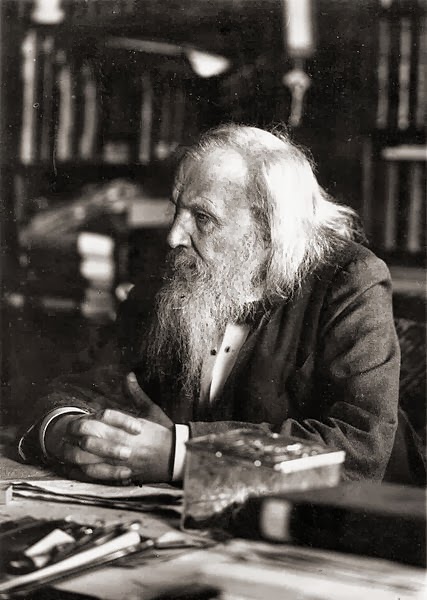
Dimitri Mendeleev (#59)

Background

Dimitri Ivanovich Mendeleev was born on February 8, 1834 near Tobolsk in Siberia. There is no consensus on how many siblings Mendeleev had, but all sources agree that the number was at least eleven. Dimitri's father supported the family by teaching fine arts, politics, and philosophy, but after some time, Mendeleev's father became blind and lost his teaching position. Mendeleev's mother was forced to restart her family's abandoned glass factory, but when he was thirteen, Mendeleev's father died and the glass factory was destroyed in a fire, so Mendeleev was sent to study at the Gymnasium in Tobolsk.

In 1850, Mendeleev's family moved to St. Petersburg and Mendeleev began to attend the Main Pedagogical Institute. After graduation in 1855, Mendeleev contracted tuberculosis and moved to the Crimean Peninsula to recover his health. While away, Mendeleev became the science master of the Simferopol gymnasium No. 1, but returned to St. Petersburg in 1857.

On April 27, 1862, Mendeleev married Feozva Nikitichna Lescheva with whom he was married to until 1882, when he became obsessed with Anna Ivanova Popova. Mendeleev divorced Lescheva and married Popova.

Career in Science

Mendeleev studied several areas in science including the capillarity of liquids and the science behind spectroscopes. In 1864, Mendeleev became a professor at Saint Petersburg Technological Institute and at Saint Petersburg State University. In 1865, Mendeleev became a Doctor of Science and achieved tenure two years later. Mendeleev is widely credited as being the man who helped Saint Petersburg become an internationally recognized center of chemistry. He is also said to have been the man who brought the metric system to Russia.

In 1869, Mendeleev was writing a book on chemistry and, while doing so, organized a table of  the 56 known elements based on atomic mass, weight, and chemical properties. This was the first periodic table ever created. Mendeleev also predicted the existence of three chemicals that would make his table make more sense. These predicted elements did exist as gallium, germanium, and scandium. The periodic table was widely expanded upon as more knowledge came in concerning the elements and their properties.

Mendeleev went on to formulate new state standards for the production of vodka in 1893 while working as the Director of the Bureau of Weights and Measures. He also helped to investigate the properties of petroleum and found the first oil refinery in Russia. He was also nominated several times for the Nobel Prize in Chemistry, but was not chosen for the award due to Svante Arrhenius, who discouraged his selection due to Mendeleev's critiques on Arrhenius's work.

The End

Before he died, Mendeleev received the Copley Medal from the Royal Society of London. He also was elected as a member of the Royal Swedish Academy of Science. Mendeleev died in 1907 at the age of 72 in Saint Petersburg due to influenza. Mendeleev has been honored by having both a crater on the moon and an element named after him. Mendeleev is on our list because he developed a table that is known world wide and can be found in almost every university and high school science classroom. Also, anyone with a moon crater named after them is pretty awesome.


Tuesday, October 1, 2013

Annie Oakley (#60)

Background

Phoebe Ann Moses was born on August 13, 1860 near Woodland, Ohio. She was the daughter of Susan Wise and Jacob Moses, the sixth child in a family of Quaker farmers. In 1866, Jacob Moses died of pneumonia and overexposure to freezing weather, leaving his family in a state of poverty.

Phoebe Ann, or Annie, began to hunt at the age of eight to support her mother and her sibling and became known for her hunting skills, but in 1870, Annie was sent to the Darke County Infirmary where she was taught to sew and decorate. She was then sent to a local family to help care for their infant son. Instead of this, Annie was forced to do many of the chores around the house and was put through both mental and physical abuse. This family, known by Annie referred to as "the wolves", didn't even give any the money she was due for her services.

In 1872, Annie returned to her family and continued to hunt for money and by the age of 15, she had paid off the mortgage on her mother's farm.

Shooting Career

On Thanksgiving Day 1875, the Baughman and Butler shooting act was being performed in Cincinnati. Marksman Francis E. Butler placed a $100 bet with hotel owner Jack Frost that he, Butler, could beat any local shooter in a competition. Frost arranged for Butler to compete with the then 15-year-old Annie. On the 25th shot of the match, Butler missed his shot, losing the match and the bet. He began courting Annie soon afterwards and married her on August 23, 1876.

Annie and Butler began to perform together, and Annie took the name "Oakley" after the neighborhood that they lived in. In 1885, Annie and Butler joined Buffalo Bill's Wild West Show. Because she was an excellent shooter but only stood 5 feet tall, Sitting Bull referred to her as "Watanya Cicilla", or Little Sure Shot, which would become her name in public advertisements. When the show went to Europe, Annie performed for Queen Victoria, King Umberto I of Italy, PResident Marie Francois Sadi Carnot of France. She had such good aim that, at his request, Annie was able to shoot the ashes off a cigarette held by Kaiser Wilhelm II of Germany. Some say that if Annie had missed and hit Wilhelm instead, she might have stopped WWI from happening.

During her time as a sharpshooter, Annie fought for women's rights, saying that women should be allowed in the military and should be taught how to use a gun. It is estimated that in her lifetime, Annie taught 15,000 women how to use a gun.

The End

In 1901, Annie was hurt in a train accident which left her in temporary paralysis that was fixed after five spinal operations. In 1902, Annie left the Wild West Show and began a career in acting, though she continued to set records in shooting until 1922. On November 3,1926, Annie died of pernicious anemia. Annie is on our list for overcoming both height and gender barriers and becoming one of the greatest sharpshooters the world has ever scene.


Thursday, September 5, 2013

Johann Strauss II (#61)

Background

Johann Baptist Strauss II was born on October 25, 1825 outside the city of Vienna. His father, Johann Strauss I, was a famous musician, but Johann Strauss Sr. did not want his son to be a musician, but a banker. Against his father's wishes, Strauss Jr. learned how to play violin from the first violinist of his father's orchestra. When his father found out, Strauss Jr. was beaten. It was not until his father abandoned his family for a mistress that Strauss Jr. was able to concentrate on his career as a composer. 

Musical Career

Strauss studied music theory under Joachim Hoffmann and continued to learn violin under Anton Kollmann. With this education, Strauss was able to gain a Viennese license to perform. Strauss's debut was made at Dommayer's Casino in October of 1844, where critics unanimously praised Strauss's original pieces. When Strauss began accepting commissions, he earned much fame and was given the musical position of Kapellmeister of the 2nd Vienna Citizen's Regiment.

As Strauss's career grew, the competition between himself and his father grew larger as well. When bourgeois revolution broke out in 1848, Strauss Jr. sided with the revolutionaries. Because of this, the musical title of KK Hofballmusikdirektor was given to Strauss Sr. rather than Strauss Jr. Johann Strauss the Younger was also arrested during he revolution for playing revolutionary music, but he was later acquited.

When his father died of scarlet fever in 1849, Strauss merged their orchestras and engaged in further touring. To regain the trust of the royalty in Vienna after his siding with revolutionaries, Strauss wrote many patriotic songs dedicated to the new Habsburg Emperor Franz Josef I. 

After recovering from a nervous breakdown in 1853, Strauss's career grew once more. Strauss began to perform in St. Petersburg in Russia in 1855 and performed their each year for ten years. Also, the KK Hofballmusikdirektor position, the musical position he had had applied for several times, was finally given to Strauss in 1863. In the 1870s, Strauss traveled to the United States, where his shows were widely popular.

The End

Strauss died in 1899 from pleural pneumonia in 1899 at the age of 73. Today, Strauss has become most famous for his piece, the "Blue Danube" waltz. Strauss is on our list for writing such a memorable piece, but also for being such a centerpiece in the music scene. Strauss inspired many composers, including Richard Wagner. Strauss was also good friends with the composer Johannes Brahms. During Strauss's lifetime, it was customary for composers to sign women's fans with their name and a section of a piece of music they wrote. When Brahms signed the fan of Strauss's wife, he inscribe a few measures from Strauss's music and wrote "Unfortunately, not by Johannes Brahms."


Saturday, August 31, 2013

Jack the Ripper (#62, August 31st)

Background

In the mid-1800s, many immigrants were flooding into London, mainly into London's East End. Irish immigrants were coming from the West, and Jewish Immigrants were coming from the East. The sudden jump in population led to worsening of conditions in London. On April 3rd, 1888, the first of eleven "Whitechapel Murders" took place in London's East End.

Murders

During the investigation process of these eleven murders, at least five are assumed to have been committed by the same person, who became known as Jack the Ripper. On August 31st, 1888, the body of Mary Ann Nichols was found, with her throat cut and her abdomen ripped open. From that date to November 9th, 1888, there were four more murders, each similar to the one described above. Each murder victim was a poor women, and each body was mutilated, some even having organs missing. 

As the police investigated the Whitechapel murders, it was assumed that the Ripper was a man who lived in London and worked during the week. This was assumed because the Ripper struck around a certain area of town each time, yet only struck during the weekend. The police first investigated surgeons, butchers, other workers who handled knives, believing that people of these occupations were more likely to kill victims by cutting them with knives. Unfortunately, all the main suspects had alibis that checked out.

There were hundreds of letters sent to the police and the newspapers whose authors claimed to be Jack the Ripper. In the letter known as the "Dear Boss" letter, the author became the first to use the name Jack the Ripper, which became a world famous name. In another letter, known as the "From Hell" letter, the author sent half a kidney, which the author claimed was the kidney of Catherine Eddowes, who had had her kidney stolen during her murder by the Ripper. The author also claimed that he had cooked and eaten the other half of the kidney. Though most letters were immediately thrown out as hoaxes, the "From Hell" letter was kept, though it was never discovered whether the kidney was indeed Eddowes's.

As the murder investigation progressed, the media caught onto the story. Tax reforms had made printing newspapers much cheaper than before, and Jack the Ripper's story was one of the first to be widely distributed throughout the city and the country. 

The End

The true identity of Jack the Ripper was never discovered, though policemen investigated the murders until 1931. Jack the Ripper became a legend, a fairy tale to scare children into being good. The Ripper's appearance also helped to bring media attention to the poor living conditions of London's East End. Jack the Ripper is on our list for being one of the few people who remain famous (or infamous) without actually having a face to put with their name.


Friday, August 30, 2013

Battle of San Juan del Monte (August 30th)

On July 7th, 1892, Jose Rizal, a Filipino writer who critiqued Spanish government, was banished from the Philippines. Because of this, Filipino patriots, led by Andres Bonifacio, founded the Kataas-taasan, Kagalang-galang Katipunan ng mga Anak ng Bayan. In English, this means The Highest and Most Honorable Society of the Children of the Nation. This Katipunan was a secret revolutionary organization that stayed secret until 1896.

In 1896, the Katipunan sent a delegation to the Emperor of Japan in order to solicit funds and weapons. When one member of the Katipunan, Teodoro Patino, went to the Spanish authorities, the existence of the Katipunan was realized. On August 26th, 1896, the members of the Katipunan tore up their identification cards and began the Philippine Revolution.

On the night of the 29th of August, 1896, Bonifacio led his men to El Polvorin, a Spanish powder magazine in San Juan del Monte. At 4:00am on August 30th, 1896, after two unsuccessful attempts at taking the powder magazine, Bonifacio made his surprise attack on the Spanish soldiers stationed at El Polvorin. Though the Spanish soldiers had rifles and the Filipinos only had bolo knives, a few guns, and bamboo spears, Bonifacio was able to take El Polvorin. The Spanish retreated, but regrouped, and with reinforcements, the Spanish were able to recapture the powder magazine, capturing 200 Filipino patriots and killing another150. Banifacio and his remaining men were forced to retreat.

On August 30th, 1896, Governor-General Ramon Blanco y Erenas declared the eight provinces of Manila under martial law. The Philippine Revolution continued until 1899, and though the Philippines was close to independence, the victory was short-lived, for that same year, Spain signed the Philippines over to America in the Treaty of Paris. Both Jose Rizal and Andres Bonifacio were executed by the Spanish Government.